Hi!
Dear english speaking readers. Due to popular demand I will translate some posts of the past to german. The language of the blog will remain english.
Auf mehrfachen Wunsch werde ich die Artkel Teil 1-3 der Reihe 'How Does It Sound?' übersetzen und hier einstellen. Bitte lasst mich wissen, falls auch an anderen Artikeln Interesse besteht. Hier nun der 1. Teil von 'Wie klingt es?':
Hallo!
Dies ist ein Thema, welches viel im Internet diskutiert wird. Das ist auch eine Frage die mir häufig gestellt wird. Egal ob es um ein Gerät, eine Röhre oder ein Bauteil geht. Viele Leser meines blogs sind verwundert, dass ich mich mit Klangbeschreibungen der vorgestellten Geräte eher zurückhalte. Der Grund ist simpel: Die Wahrnehmungen unterschiedlicher Hörer können extrem voneinander abweichen. Auch die Vorlieben und Präferenzen was am Klang wichtig ist, sind unterschiedlich. Ich habe schon sehr vielen Hörsitzungen mit mehreren Leuten beigewohnt, es ist erstaunlich wie die Wahrnehmungen voneinander abweichen können. Ich habe schon erlebt, dass einige bei Hörvergleichen zwischen zwei Komponenten total aus dem Häuschen waren wegen dem Klangunterschied, während andere diese kaum unterscheiden konnten.
Welche Aussagekraft hätte auch eine klangliche Beschreibung von mir über die von mir selbst gebauten Geräte? Die Beschreibung wäre sehr subjektiv und von meinen Vorlieben geprägt. Ausserdem wäre diese verständlicherweise voreingenommen, da ich über meine eigenen Kreationen schreibe. Welchen Wert hätte also solch eine Beschreibung für andere? Trotzdem kann ich verstehen, wenn ein Bedarf an klanglicher Beschreibung besteht, insbesondere, wenn man keine Möglichkeit hat die betreffende Komponente selbst zu hören.
Also habe ich beschlossen ein bischen was darüber zu schreiben, wonach ich generell suche, in Bezug auf die klanglichen Eigenschaften. Die Artikel mit Plattenbeschreibungen geben schon einen guten Einblick, welche Art Musik ich mag.
Mir ist ein hoch aufgelöstes und detailreiches Klangbild wichtig. Möglichst neutral und transparent. Dabei sollten die Klangdetails nicht vom musikalischen Fluss ablenken, sondern sich harmonisch integrieren. Viele sind der Meinung, dass hohe Auflösung und emotional involvierende Wiedergabe unvereinbar sind, ich strebe beides an. Gerade die Auflösung ist wichtig für eine gute Stimmenartikulation und Sparchverständlichkeit. Besonders s- und Zischlaute sind sehr kritisch und hier versagen viele Verstärker, insbesondere Phonostufen. Viele Geräte ermöglichen es nicht oder kaum zwischen 's', 'ch'. 'sch', 'ts' oder 'z' -Lauten zu unterscheiden, sondern verschmieren diese zu einem Zischeln. Oft wird das dann der Aufnahmetechnik zugeschrieben. Insbesondere Phonostufen mit LCR-Entzerrung spielen hier ihre Stärke aus. Diese können diese Laute deutlich herausarbeiten und unterschiedbar machen.
Räumliche Wiedergabe ist mir nicht mehr so wichtig. Das war sie mal vor vielen Jahren, aber ich habe das Interesse daran verloren. Wenn ich Musik höre sitze ich oft nichtmal in der typischen Stereodreieck-Position, sondern irgendwo seitlich. Allerdings haben mir Hörer, die von mir gebaute Geräte benutzen und Wert auf gute Raumabbildung legen, bescheinigt, dass meine Verstärker hier nichts zu wünschen übrig lassen.
Ich baue meine Geräte so, dass sie fein aufgelöst und trotzdem weich klingen. Mir sind Klangfarben wichtig, die feinen Nuancen eines Vibraphons z.B., wenn Amplitude und Frequenz leicht vibrieren nach dem Anschlag. Die Attacke eines Pianos, wenn die Tasten hart angeschlagen werden, sowie der leichte Fluss der Noten wenn es sanft gespielt wird. Bei einem Piano muss beides, der Stahl der Seiten und das Holz des Gehäuses hörbar sein. Ich will nicht den viel zitierten rabenschwarzen und staubtrockenen Bass. Für mich gibt es keinen schwarzen Bass sondern tausende Nuancen verschiedener Braun- und Grautöne von Hell bis Dunkel. Trockener Bass ist langweilig, ich will meinen Klang 'feucht' und anmachend.
Ein weiterer wichtiger Punkt ist die Atmosphäre oder Stimmung. Die Stille zwischen den Klängen. Ein guter Verstärker transportiert diese Stimmung, die Gegenwart von Menschen bei der Aufnahme. Zusammenfassend sollte der Hörer in die Musik hineingezogen werden und dabei die Technik vergessen, nur dann erfüllt diese ihre Aufgabe. Wenn eine Kette die oben beschriebenen klanglichen Eigenschaften hat, dann erfüllt sie dies für mich. Wenn ich einen neuen Verstärker oder Vorverstärker fertig gestellt habe, schliesse ich diesen für einen ersten Probelauf an die Anlage an. Dann mache ich mir einen Kaffee, zünde mir eine Zigarre an und setze mich auf die Terrasse und lasse die Tür zum Hörraum offen. Ist das Gerät gut, wird es selbst so klanglich überzeugen. Das ist ein guter Test, den alle Geräte bei mir durchlaufen.
Mir geht es um die grossen Klangunterschiede, die man auch aus dem Nebenraum oder der Küche heraushört. Die letzten Jahre gibt es einen Trend, insbesondere in der Hochglanzpresse, sich mehr und mehr mit albernen Details zu beschäftigen, die winzige Klangunterschiede ausmachen. Kabel, Netzkabel, Racks, usw. Sicher, nahezu alles an einer Anlage hat einen klanglichen Einfluss. Aber solange ich viel größere Klangunterschiede mit anderen Massnahmen erzielen kann, finde ich das Beschäftigen mit solchen Details langweilig. Mein Fokus liegt bei Schaltungstopologien, Röhrenarten, usw.
Inzwischen ist die Meinung weit verbreitet, dass sich die Verstärkertechnik bereits so weit entwickelt hat, dass mit anderen Schaltungen nichts mehr rauszuholen ist und man nur noch mit Feinsicherungen oder Netzkabeln kleine Unterschiede erzielen kann. Insbesondere die Hochglanzmagazine nähren diesen Glauben. Ich denke gerade bei Verstärkern und insbesondere Vorstufen ist noch viel rauszuholen und das ist noch ein langer und interessanter Weg. Ich bin sogar der Meinung, dass ein gut konstruierter Verstärker nicht sonderlich auf seine Umgebung reagieren sollte. Wenn Netzkabel oder Sicherungen einen Einfluss haben, ist das für mich vielmehr ein Zeichen dass das Schaltungskonzept verbesserungswürdig ist.
Generell stelle ich auf meinem blog nur Konzepte vor, deren Klang mich überzeugt und die meine beschriebenen Anforderungen erfüllen. Die aufwändigeren Geräte bieten einfach mehr von allem. Aber selbst meine Einsteigerkonzepte haben all die beschriebenen klanglichen Eigenschaften, mit kleinen Einschränkungen z.B. bei der Auflösung.
Ich hoffe meine Beschreibung meiner klanglichen Vorlieben hilft etwas die vorgestellten Geräte einzuordnen. Allerdings sollte immer die eigene Einschätzung zählen. Nichts geht über das Selbsthören. Man sollte sich nie nur auf die Einschätzungen anderer verlassen. Dazu sind die Hörgewohnheiten und das Empfinden zu unterschiedlich. Was dem einen als hoch aufgelöst und detailliert erscheint, mag ein anderer als nervtötend empfinden.
Das menschliche Gehör ist ein extrem komplexer und weit entwickelter Sinn. So unglaublich seine Wahrnehmungsfähigkeiten sind, so sehr kann es auch in die Irre leiten. Manchmal will jemand einfach einen Unterschied hören, dann wird er diesen auch wahrnehmen. Umgekehrt genauso. Will man keinen Unterschied hören, dann wird sich auch keiner offenbaren. Wenn ich während der vielen Jahre, die ich mich mit Audio beschäftige, eins gelernt habe: Nichts als gegeben hinnehmen. Hörst Du keinen Unterschied, heisst das nicht, dass da keiner ist. Und umgekehrt: Nur weil Du einen Unterschied hörst, heisst das nicht, dass es wirklich einen gibt.
Viele Grüße
Thomas

This is Thomas Mayer's blog about vacuum tube audio, to share updates about new amplifiers and preamplifiers and ELROG vacuum tubes.
Thursday, October 4, 2012

Sunday, September 30, 2012
Tube of the Month: The 841
Hi!
As mentioned in last months post about the 836, the next few Tube of the Month articles will cover transmitting tubes from the 800 series. After covering a rectifier, the next few articles will be about triodes. Starting with a directly heated tube with thoriated tungsten filaments, the 841.


 Only a few DHTs have amplification factors which make them suitable to get significant gain. Most of the higher mu ones with an amplification factor in the two digit range have very high plate resistances which limit their usability. The 841 is basically a modified 801 with the grid spacing altered to increase the amplification factor. Dispite it's high mu it has a still moderately low plate resistance of 40 kOhm. Too high for transformer coupling, but perfectly usable with RC coupling. Even LC coupling seems feasable with a suitable plate choke. The 841 has the same UX4 base and pinout as most DHTs. The base connections are pictured on the left. The complete RCA datasheet can be found here. As with most directly heated tubes, the preferred mounting position is up right with the base down. The RCA datasheet allows horizontal mounting if the plane of the electrodes is vertical. This avoids shorting of the filament to the grid. The filaments are quite flexible and can sag a little when mounted horizontally. Keeping the electrode plane vertical avoids the hazard of a short. Still I prefer to mount all DHTs up right. The 841 was manufactured by various of the large tube companies. The military designation of the tube is VT-51.
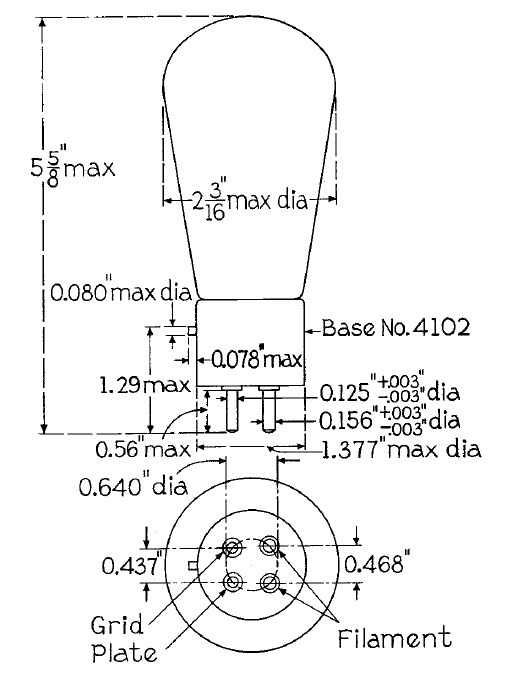
 The tube has the same size as the 801A or 2A3. Dimensions can be found in the illustration on the right. As mentioned, the high amplification factor opens the possibility to use this tube in preamps. I actually plan to use it an a phonostage. Most likely with a plate choke and DC coupled to a 801A which will be transformer coupled for low output impedance. The 841 could also be used as a driver tube for DHTs which are easy to drive like the 801A or 45. This would enable a two stage all DHT power amp without the need of a step up input transformer to get sufficient gain. I have not used it this way yet but this is another project for the future. One of the most important aspects of the usability of a tube for audio amplifiers is it's linearity. The plate curves of the RCA datasheet look promising:


 Initially the 841/VT51 was also made with globe shaped glass before the manufacturers moved to the more modern ST-shape. Like many tube enthusiasts I like the appearance of the older globe shapes. Many people including myself also prefer the sound of globe shaped tubes. Although they can be more microphonic as those with shoulder type glass, they seem to be worth it. A reason for the increased microphonics of globes is the lack of mechanical support of the electrodes on the top. The ST shape was introduced to provide extra support through a sheet of mica which stabilizes the tube structures. But the lack of that mica in the globe tubes might be a reason for their better sound since the mica can release some gas during the life time of the tube. In fact I found most globe tubes to have excellent vacuum dispite their age. A beautiful Taylor globe 841:


As mentioned in last months post about the 836, the next few Tube of the Month articles will cover transmitting tubes from the 800 series. After covering a rectifier, the next few articles will be about triodes. Starting with a directly heated tube with thoriated tungsten filaments, the 841.
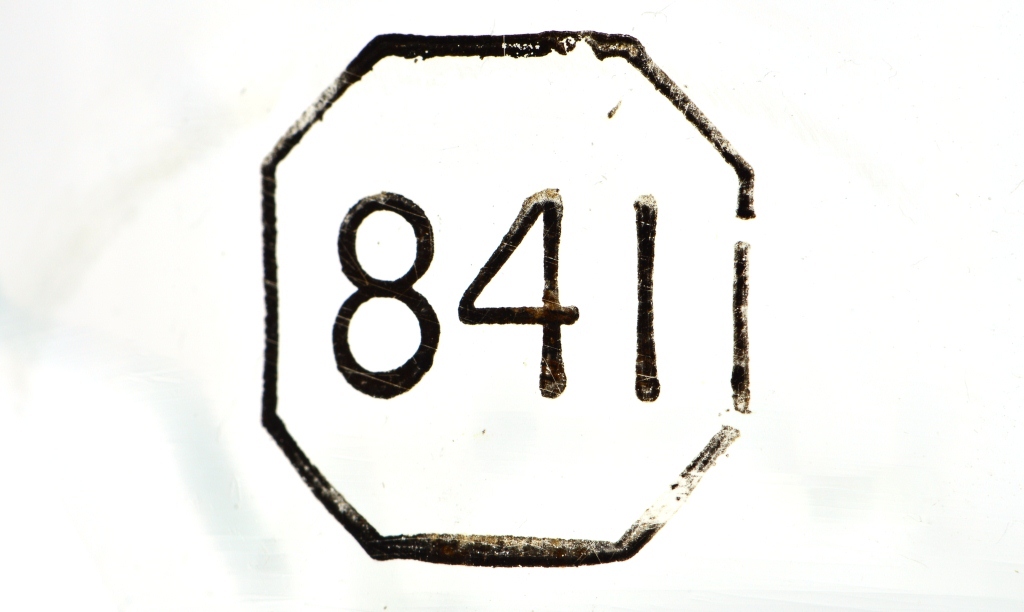


The 841 is a very interesting tube since it is a directly heated triode with a rather high amplification factor of 30. Every tube amp builder who is into directly heated triodes, at a certain point wants to use them in other sockets besides just the output stage. Especially when it comes to preamps, the rather low mu of typical DHTs is a problem.
 Only a few DHTs have amplification factors which make them suitable to get significant gain. Most of the higher mu ones with an amplification factor in the two digit range have very high plate resistances which limit their usability. The 841 is basically a modified 801 with the grid spacing altered to increase the amplification factor. Dispite it's high mu it has a still moderately low plate resistance of 40 kOhm. Too high for transformer coupling, but perfectly usable with RC coupling. Even LC coupling seems feasable with a suitable plate choke. The 841 has the same UX4 base and pinout as most DHTs. The base connections are pictured on the left. The complete RCA datasheet can be found here. As with most directly heated tubes, the preferred mounting position is up right with the base down. The RCA datasheet allows horizontal mounting if the plane of the electrodes is vertical. This avoids shorting of the filament to the grid. The filaments are quite flexible and can sag a little when mounted horizontally. Keeping the electrode plane vertical avoids the hazard of a short. Still I prefer to mount all DHTs up right. The 841 was manufactured by various of the large tube companies. The military designation of the tube is VT-51.
 The tube has the same size as the 801A or 2A3. Dimensions can be found in the illustration on the right. As mentioned, the high amplification factor opens the possibility to use this tube in preamps. I actually plan to use it an a phonostage. Most likely with a plate choke and DC coupled to a 801A which will be transformer coupled for low output impedance. The 841 could also be used as a driver tube for DHTs which are easy to drive like the 801A or 45. This would enable a two stage all DHT power amp without the need of a step up input transformer to get sufficient gain. I have not used it this way yet but this is another project for the future. One of the most important aspects of the usability of a tube for audio amplifiers is it's linearity. The plate curves of the RCA datasheet look promising:

The curves from the GE datasheet:

How do these curves match to the reality? Let's have a look at the actual curves taken with a curve tracer:

This looks quite linear to me. So based on the electrical data this tube appears perfectly usable for audio. Another concern, especially in preamps, is microphonics. The further upstream in the signal path a tube is used, the more critical are microphonics. I have done a lot of experiments with DHTs in preamps already. With 801s I found those with ceramic base and graphite plates the least microphonic. So for phono stage use this french 841 from Mazdaradio seems very promising:

Some close up shots of this tube:


Next a VT51 from Hytron:

 Initially the 841/VT51 was also made with globe shaped glass before the manufacturers moved to the more modern ST-shape. Like many tube enthusiasts I like the appearance of the older globe shapes. Many people including myself also prefer the sound of globe shaped tubes. Although they can be more microphonic as those with shoulder type glass, they seem to be worth it. A reason for the increased microphonics of globes is the lack of mechanical support of the electrodes on the top. The ST shape was introduced to provide extra support through a sheet of mica which stabilizes the tube structures. But the lack of that mica in the globe tubes might be a reason for their better sound since the mica can release some gas during the life time of the tube. In fact I found most globe tubes to have excellent vacuum dispite their age. A beautiful Taylor globe 841:


Some close up photos:


Next photos of a stunning globe 841 from General Electric:

And some close ups:


It has become a tradition of the Tube of the Month series, to dissect a tube and to have a close look at the internal construction. Luckily I had a dead 841 to take appart. First the glass needs to be removed:


The filament tension springs:

The grid structure:


A closer look:

A comparison between the grid of a 801A (top) and a 841 (bottom):

The tighter grid spacing is responsible for the higher amplification factor.
A very promising tube! Stay tuned for updates about it's use in an upcoming phono stage!
Best regards
Thomas
Sunday, September 23, 2012
Vanity Plates
Hi!
No this post is not about imaginary or otherwise stange anodes. This is about car licence plates which are personalized to express a message. In many countries, a specific combination of letters and digits can be chosen, usually for an extra fee. Being totally into tubes, my licence plates always have a tube type in them. I just got the plates for my new car, so I thought this might make a nice topic for the blog.

In Germany there are certain restrictions, how the licence plate can be personalized. The plate always starts with a 1-3 letter prefix which specifies the region. Then it is followed by 1 or 2 letters and up to 4 digits (depending on region).
Since it is among my favorite tubes, the 45 makes a perfect theme for a licence plate, of course in it's original incarantion as UX245.

In the US there is much more freedom how you can personalize your plate. My friend Jeremy sent a photo of his:


Next the licence plate of Dietmar, a long time member of the Munich Triode Mafia. Dietmar is famous for his incredible loudspeaker creations, he builds nice tube amps too:

The plate from my friend Bernd, obviously a DHT aficionado:

This is the plate of my current car:

And my girl friend's:

And finally the plate of my previous car, which was my very first automobile, this was from the time, when I still lived in Munich:

Of course that one had to carry the name of my all time favorite indirectly heated tube! I donated the second EC8020 plate to the auction of the 2005 European Triode Festival. It was sniped by Christian, who likes such awkward stuff.
Do you have a licence plate with a vacuum tube theme too? Send a photo and I will publish it!
Best regards
Thomas
No this post is not about imaginary or otherwise stange anodes. This is about car licence plates which are personalized to express a message. In many countries, a specific combination of letters and digits can be chosen, usually for an extra fee. Being totally into tubes, my licence plates always have a tube type in them. I just got the plates for my new car, so I thought this might make a nice topic for the blog.

In Germany there are certain restrictions, how the licence plate can be personalized. The plate always starts with a 1-3 letter prefix which specifies the region. Then it is followed by 1 or 2 letters and up to 4 digits (depending on region).
Since it is among my favorite tubes, the 45 makes a perfect theme for a licence plate, of course in it's original incarantion as UX245.

In the US there is much more freedom how you can personalize your plate. My friend Jeremy sent a photo of his:

Quite appropriate, since it matches the name of his blog. He used to have this plate a long time, here is a photo of an older one:

Next the licence plate of Dietmar, a long time member of the Munich Triode Mafia. Dietmar is famous for his incredible loudspeaker creations, he builds nice tube amps too:

The plate from my friend Bernd, obviously a DHT aficionado:

This is the plate of my current car:

And my girl friend's:

And finally the plate of my previous car, which was my very first automobile, this was from the time, when I still lived in Munich:

Of course that one had to carry the name of my all time favorite indirectly heated tube! I donated the second EC8020 plate to the auction of the 2005 European Triode Festival. It was sniped by Christian, who likes such awkward stuff.
Do you have a licence plate with a vacuum tube theme too? Send a photo and I will publish it!
Best regards
Thomas
Sunday, September 16, 2012
How Does It Sound? (Part 3)
Hi!
In part 1 and part 2 of this series of articles I wrote a lot about my thoughts of sound, especially what I am looking for in terms of how a system should sound. In the recent time I often was asked how certain amps or even parts sound and I see an increasing amount of discussion about the sound on forums recently. So I thought it's time for another post about this topic.
While I can understand that people want to gather information about the sound of an amp or any other component before they make a decision, I would like to remind you about the subjectivity in sound judgements and also the system synergy which is involved. There are so many aspects involved in the overall sound result of a system. It is impossible to derive the contribution of a single component and how it would work in another context.
A topic often discussed among DIYers is the sound of the output tube. I already covered that in the last article. Besides the output tube, the next component which is most often discussed is the output transformer. Whenever somebody asks about the 'best' transformer for a certain tube, he will get a whole array of suggestions. Most often all other parameters around the output stage are completely ignored. There is a wide range of suitable load impedances for each tube and yet a wider range of speakers which can be connected. All this should be carefully considered. What might work well with one speaker can sound mediocre with another. Sometimes the seemingly lesser quality transformer can be the better choice in a certain system. Most important is a sensible overall balance. It is quite pointless to pick the transformer which is recommended from most people if the rest of the amp is not up to the task. The transformer which gets the most praise is often quite costly. It would be a big mistake to invest most of the budget in output tube and transformer and then cheap out with the driver stage and power supply. This will yield a worse sounding amp than balancing the budget. Rather get a more affordable output transformer and invest also in a good driver stage and decent power supply. These contribute just as much to the result. As a rough guideline I would recommend to spend about equal amounts of the budget for driver, power supply and output stage. I even have built amps with a driver stage that was more costly than the output stage and the sound result was well worth it.
Whenever you have the chance to listen yourself, do that and trust your own ears, no matter what others say. Many people seem to go for opinions they read in the internet or in magazines rather than choosing what they like best. Keep in mind that everybody has different tastes and preferences. The opinion which you read somewhere might be written by someone who likes a totally different sound than you! For many listeners all that counts is soundstage and a holographic presentation. They often listen only for that and tend to ignore other aspects of the sound. For others soundstage is completely irrelevant and they cosnider it as some artificial effect. Some like extreme resolution and want to be able to hear every bit of detail. Others find that distracting and are looking for ambience and tone.
But how should you get started if you haven't had the chance to listen to many systems yet. May be you live in a remote area where it is diffucult to find other people to have joint listeng sessions. Then the internet seems to be the sensible choice to get advice. This is understandable. Just take some precaution whenever you read about sound evaluations. Try to understand the context in which the system or component was evaluated. Try to get a feel for what the listener is preferring in terms of sound. Does it resemble your own preference? What were the sources used? A sound judgement done with digital front end might be less useful for you if you are a die hard analog junkie. Also keep in mind that people tend to be enthusiastic about anything which they just got or changed. Often the fact that soemthing sounds different leads to the judgement that it's better. Rarely will people correct their first enthusiastic rant about a new amp or new output transformer when they realised that it was not really better after they lived a while with it. If you want to rely one someone else's judgement get a feel about what they like. Also how their systems evovled over the years. Is there a consistent path in the development or a wild jumping around from one extreme to the other.
The more someone rants about how things made a 'day and night' difference in sound, the bigger the grain of salt you should take this with. In a well evolved system, no change will make a huge difference. That would be a sign that the system was not at a very high level before the change.
Although I wrote about power amps mostly above, the same is valid for other areas of the system especially when it comes to preamps there are a whole lot of things coming into play how they fit into the system in terms of output impedance and overall gain. A topic that shall be covered in a future installment of 'How Does It Sound?'. Stay tuned!
Best regards
Thomas
Thursday, August 30, 2012
Tube of the Month: The 836
Hi!
With last months tube of the month post I started a small series of articles about transmitting type tubes. Although I use a lot of TV damper tubes as rectifiers, there are also some 'real' rectifiers which I like. One of them the 866A which was already covered in an article last year. This months tube is a vacuum rectifier, the 836:

Like the 866A, the 836 is a single diode. Two of them are needed for a full wave rectifier or four oif them for a full wave bridge. It has the same pinout as the 866A, a UX4 base and a medium size cap.
 The pinout can be seen on the left. Only two of the base pins are used for filament connections. The plate is brought out to the cap. The 836 is of the indirectly heated type. It has two cathodes which are internally connected to either side of the filament. Unless it is used at the very limits, a 836 has characteristics similar to the 866A. In many applications they can be interchanged. This is especially useful if you build a power supply with the 866A but want to test it with a vacuum rectifier first. Or you only use the mercury vapour tubes at special occasions, when you want to savor the blue glow. Since the 836 is indirectly heated, it has a fairly low voltage drop as can be seen in the plate characteristic curve:


 With a size of over 16cm and a diameter of about 5.5cm a pair of these looks quite impressive on a power supply! Being a vaccum rectifier the 836 does not need any special precautions like 30sec warm up before plate voltage can be applied or even 30min warm up after they have been in transport. They are as straight forward to use as any other indirectly heated rectifier and provide a nice, slow ramp up of the high voltage output. There is also no restriction with regard to mounting position. While a mercury vapour tube shall always be operated vertically and base down, the 836 can be use din any position. This tube was manufactured by all major companies which produced transmitting tubes. Here is a selection of 4 different 836:

Here is a close up of the logo of an Electronic Enterprises Inc. tube:

The base of a Marshall Electronics 836:

Let's have a closer look at the construction of the tube. The next photo shows the plate structure:

Inside the two tubes in the plate structure are two separate cathode sleeves with the filament inside.


A 836 with the heater lit up:

A close up of the top:

As mentioned at the beginning of the post, this is the second article of a small series about transmitting type tubes. Over the next month I will cover more tubes from the 800 series, stay tuned!

Best regards
Thomas
With last months tube of the month post I started a small series of articles about transmitting type tubes. Although I use a lot of TV damper tubes as rectifiers, there are also some 'real' rectifiers which I like. One of them the 866A which was already covered in an article last year. This months tube is a vacuum rectifier, the 836:

Like the 866A, the 836 is a single diode. Two of them are needed for a full wave rectifier or four oif them for a full wave bridge. It has the same pinout as the 866A, a UX4 base and a medium size cap.
 The pinout can be seen on the left. Only two of the base pins are used for filament connections. The plate is brought out to the cap. The 836 is of the indirectly heated type. It has two cathodes which are internally connected to either side of the filament. Unless it is used at the very limits, a 836 has characteristics similar to the 866A. In many applications they can be interchanged. This is especially useful if you build a power supply with the 866A but want to test it with a vacuum rectifier first. Or you only use the mercury vapour tubes at special occasions, when you want to savor the blue glow. Since the 836 is indirectly heated, it has a fairly low voltage drop as can be seen in the plate characteristic curve:

A beautiful tube with a nice large ST (shoulder type) glass bottle which is the same size as a 300B:

 With a size of over 16cm and a diameter of about 5.5cm a pair of these looks quite impressive on a power supply! Being a vaccum rectifier the 836 does not need any special precautions like 30sec warm up before plate voltage can be applied or even 30min warm up after they have been in transport. They are as straight forward to use as any other indirectly heated rectifier and provide a nice, slow ramp up of the high voltage output. There is also no restriction with regard to mounting position. While a mercury vapour tube shall always be operated vertically and base down, the 836 can be use din any position. This tube was manufactured by all major companies which produced transmitting tubes. Here is a selection of 4 different 836:

Here is a close up of the logo of an Electronic Enterprises Inc. tube:

The base of a Marshall Electronics 836:

Let's have a closer look at the construction of the tube. The next photo shows the plate structure:

Inside the two tubes in the plate structure are two separate cathode sleeves with the filament inside.

At the top end both filaments are connected by the thick metal wire on top of the ceramic support:

A 836 with the heater lit up:

A close up of the top:

As mentioned at the beginning of the post, this is the second article of a small series about transmitting type tubes. Over the next month I will cover more tubes from the 800 series, stay tuned!
Best regards
Thomas
Subscribe to:
Posts (Atom)