
This months tube is an indirectly heated triode, the 6P5.

In 2015 I did a small series of early small signal tubes covering the 27, 37, 56 and 76. The 6P5 is the successor of the 76.
 Electrically it is equivalent to the 76 but it has an Octal base instead of UX5. The Octal pinout is shown on the left. Otherwise it is interchangeable. For all technical parameters refer to the Tung-Sol data sheet. The 6P5 could be regarded as the transition type between the early indirectly heated triodes and the later, more modern medium mu types like 6J5 or the ubiquitous 6SN7. The 6P5 has the same pinout as the 6J5 but is not necessarily interchangeable. It might replace the 6J5 in certain applications and would provide less gain of the circuit can cope with the higher plate resistance. The 6P5 was made in ST 'shoulder type' glass, then named 6P5G or in straight sided glass, named 6P5GT. As usual let's have a look at the plate curves:
As expected as linear as you could hope for from an indirectly heated tube. Lets see a real tube on the tracer:

Admittedly I never used any 6P5 tubes myself and only have a small stock. This measly pile is all I got:
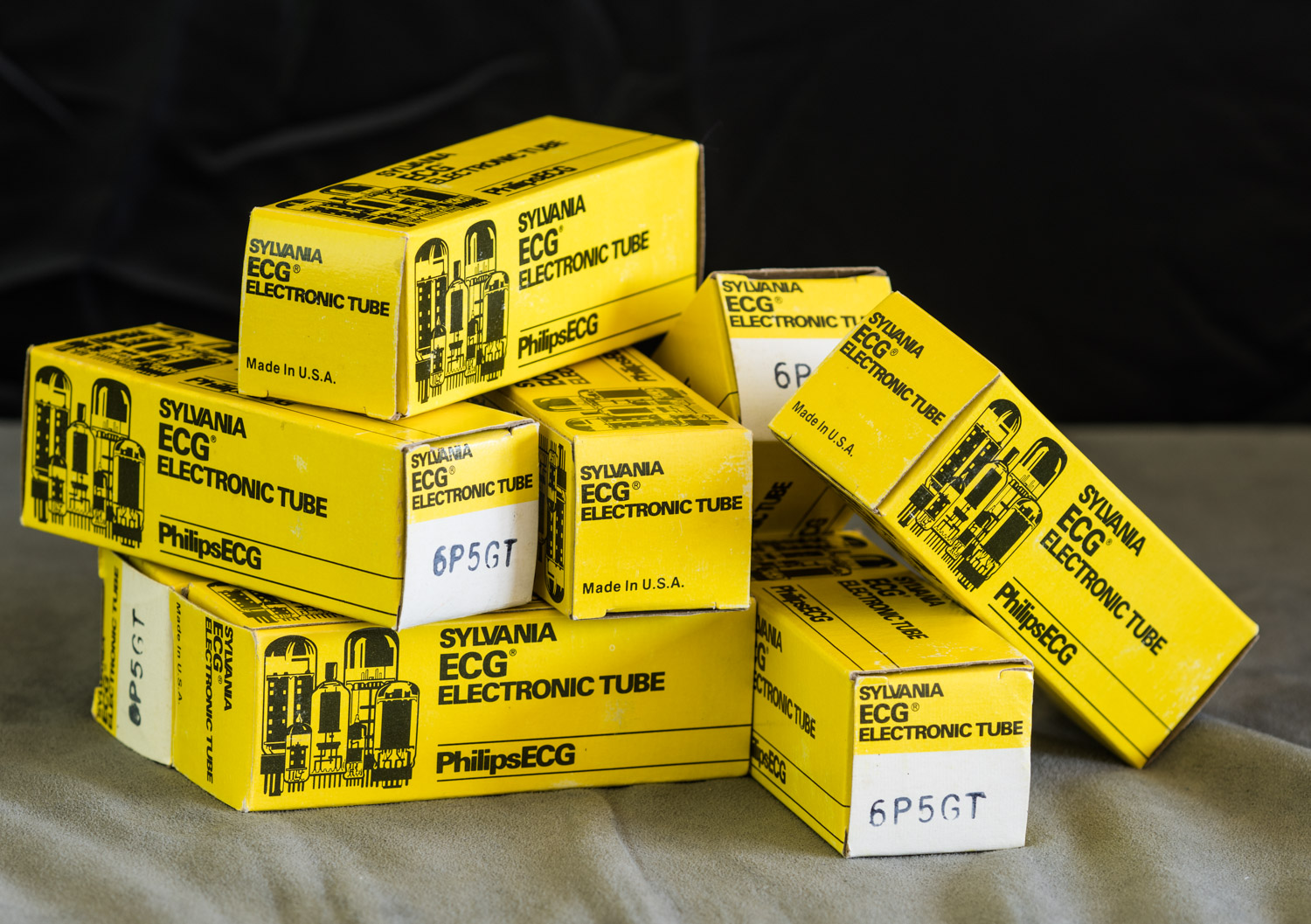
All made by Sylvania/ECG when they were part of Philips so rather late manufacture. Unfortunately I have no 6P5G shoulder types to show. Only these Sylvania 6P5GT.

Let's look at it from all sides:


Some close ups:


Details of the box:


I wish I could show more different varieties of this interesting tube.


The Octal base:

Now let's open this one to see the inner construction:

Glass removed:


Grid and cathode:

Close Ups:


The heater wire:

Cathode:

Grid:


Quite intricate engineering! When lit up not much of a light show as is usual with indirectly heated tubes:

Just a little glow from the heater at the bottom and top of the tube:


Another widely unknown but interesting tube. I hope you enjoyed the presentation.
Best regards
Thomas


