DISCLAIMER

All rights of photos and text reserved. Usage of photos or text from my blog on other websites or for any other purpose only with prior permission. If you want to use any material from my blog please contact me by email.
Showing posts with label 6FM7. Show all posts

Tuesday, April 4, 2023

The Compactron Preamplifier

Hi!

In February I showed the prototype build of my new Compactron preamplifier concept. I am happy to report that it is finished in the series production chassis.


The prototype measured a whopping 65cm in depth. Clearly too much for most racks or side boards. So a lot of effort, layout and planning was needed to cut that number down. While the result still is not exactly small, it measures 434mm by 434mm now. Height is 100mm plus feet. Here is the final product:


Let me give some background about the motivation of this preamplifier which is the first of a series of different preamps I am going to offer. Many of my customers are vinyl lovers who have multiple turntables or a turntable with multiple tonearms and cartridges. So I have often been confronted with the request to allow multiple inputs and possibility to use both MM and MC cartridges. My D3a phono preamplifiers are simplistic designs optimised for shortest possible signal path. For that reason the MC step up is always integrated in those. In addition the D3a has rather high input capacitance which is no problem for MC cartridges but could be too much for certain MMs. 
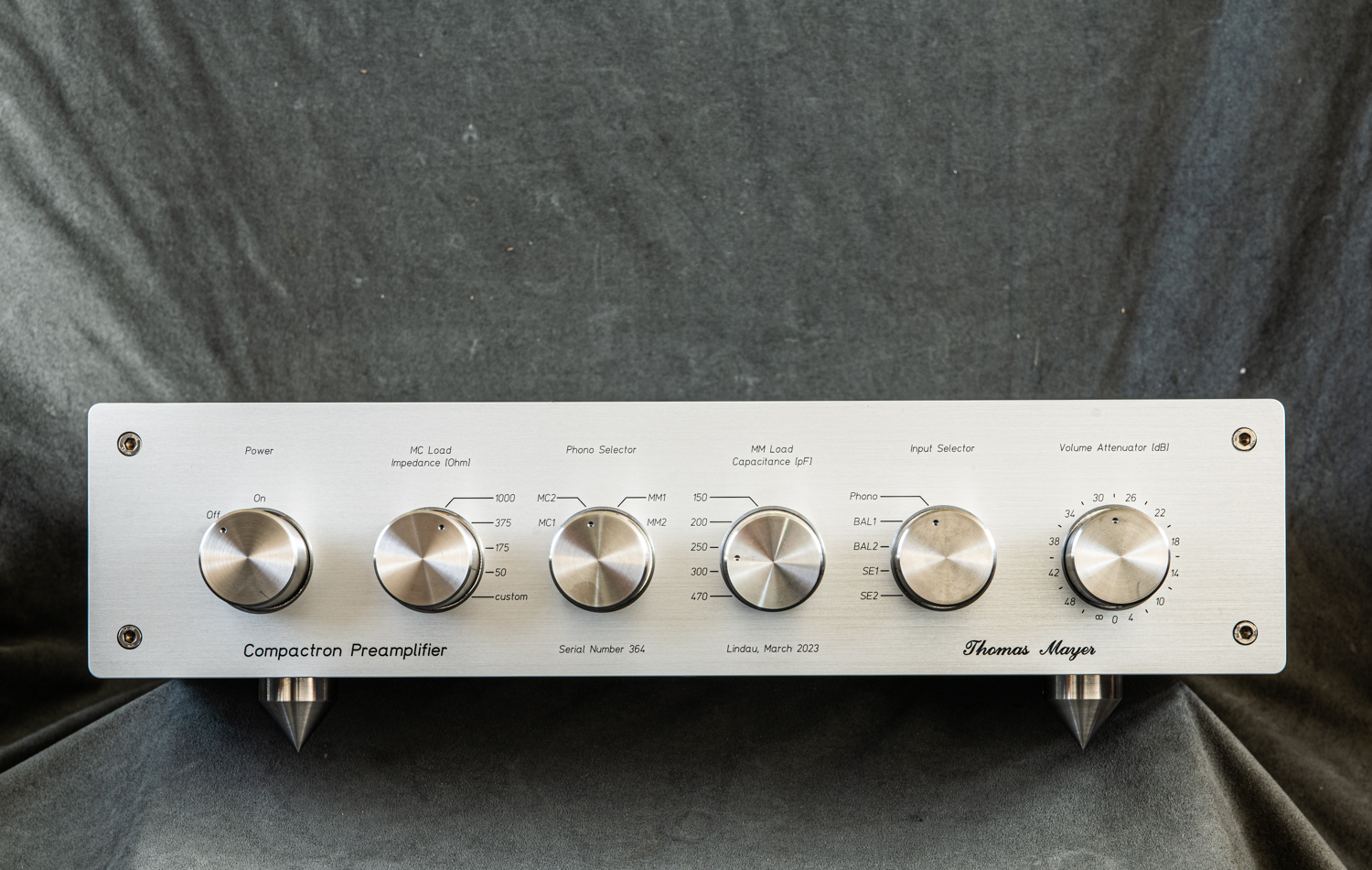


So I decided to design a new circuit based on different tubes which offers the possibility to use MMs as well. At the same time I addressed the possibility to adjust input impedance and capacitance via switches on the front. Another criticism I receive often is the sheer size of my 10Y/D3a preamplifier combo which consists of 4 chassis total. So the result is a full function preamplifier with line and phono inputs. And the power supply is integrated as well. All in one single chassis. Here a peek into the chassis when it was fully assembled:


My biggest concern was to get it hum free with a sensitive phono section and power supply all in one chassis. To address that the signal tubes are all located at the back side close to the inputs. All switches are located close to the tubes for shortest signal path. Only the power switch and the volume control switch are directly behind the front plate. For the latter this is not critical because I decided to build this unit with a maxed out line section with transformer output and transformer volume control. The volume control receives a very low impedance signal which is not prone to hum pick up. The power supply is located at the front and I could keep tube rectification and choke input filtering. the latter even for the heater voltage.


I am happy to report that the unit is not just low hum but hum free. Even without using lesser quality toroidal transformers which I already got made just in case. I could use the same high quality power transformer as in my other preamps. Above a photo half in-between construction. Here you can see the horizontally mounted tubes which give the preamplifier its name: All tubes in this unit are 12-pin Compactron tubes. The tube lineup is: 6FM7 and 6FJ7 in the signal section and 6BE3 in the power supply.


Another highlight: I managed to avoid electrolytic caps in the high voltage supply alltogether. The only electrolytics are 2 EPCOS caps in the heater supply. And yet another feature for users of many different cartridges: The gain of the phono section is selectable in 4 steps. These are the gain numbers (total gain at line out):

low gain setting: MM 42dB, MC 60dB

medium gain: MM 48dB, MC 66dB

high gain: MM 54dB, MC 72dB

maximum gain: MM 60dB, MC 78dB

You asked for all the flexibility and adjustability, here you have it.

The gain switch was a late addition and it is a bit crammed into a corner on the backside. It could also be located at the front if preferred. This switch is not just selecting different voltage dividers but changes the actual gain of different stages by adding bypass caps to the cathode resistors.


Above the back panel. Gain selector on the left, then outputs (XLR and RCA). Next a Balanced (XLR) input followed by single ended inputs. A ground lift switch in case of a ground loop in the system. Then 2 MM inputs and 2 MC inputs selectable via a front knob. The MC impedance selector has a setting marked custom. This can be used if a more specific load resistance is desired. In that case the input can be loaded with RCA plugs with resistors soldered in. These plugs go into the right most jacks. Next the ground post, mains inlet and fuse holders.


Nowadays I see many amplifiers and preamplifiers with a lot of gimmicks on the front, with nicks, crevices or waves. But I wanted something simple and discreet. Just function. A bit of a reminiscence to classic gear from the 1980ies. The result is this preamp 25kg of pure analog delight. No PCBs, no microcontrollers, no LCD display, no relays. All hand wired.


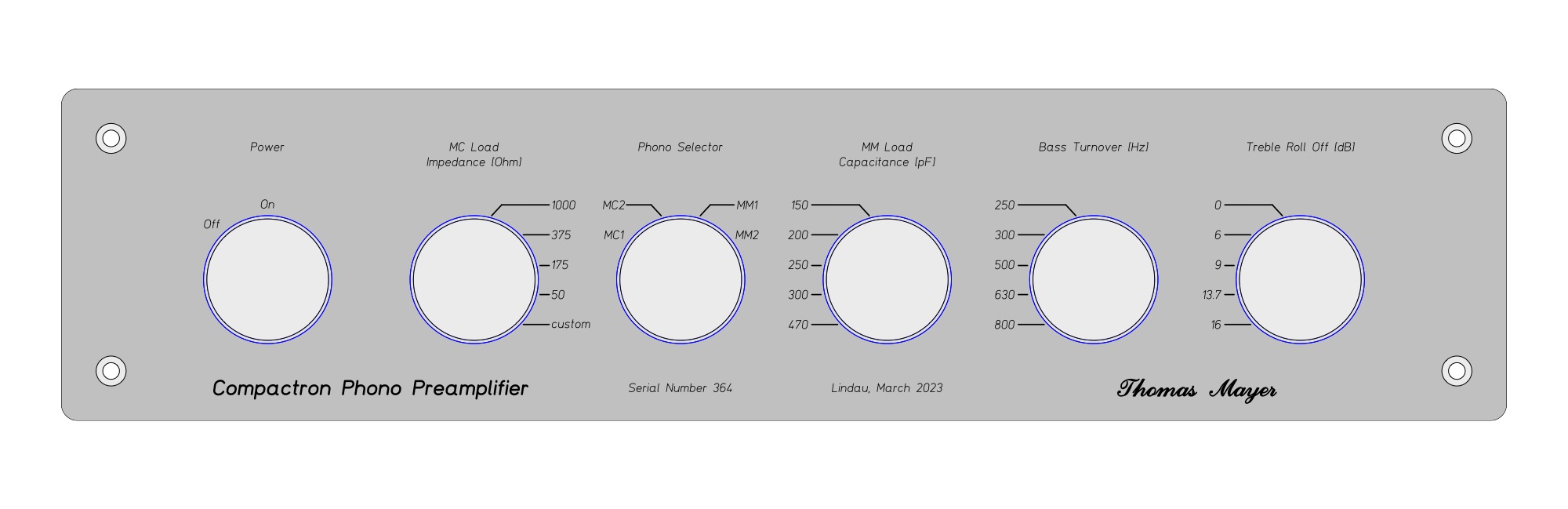
As mentioned this is just the first of a series of Compactron preamps. If you are interested in something like this, you can specify the features you want depending on your need and budget. There will also be phono and line only versions. Above the layout for a simple phono without any adjustability. Or a phono only with the same functionality as above minus the line section:


Here shown with the gain switch moved to the front. Possible options for a phono unit are transformer coupled output or just RC coupled output. Also more inputs can be added and even several different pairs of selectable built in MC step ups. Or variable EQ to allow proper playback of historic records:


Or MM only:


Want it all? Can do, just need to double the height:


Or just a simple line stage only with input selector and volume control:


The linestage can be with transformer coupled outputs with volume control or a simpler RC coupled unit.


Or need more line features like Mode select, phase switch and tape loop?

As you can see the possibilities to customise are endless. Also headphone amps can be built. Hope you understand that it is impossible to list all features that could be done and calculate their price. If interested drop me an email with a list of your requirements and I will send a quote. As an indication prices for simple phono or line only versions will start at around 5000 Euros (EU price including VAT, 4200 export).


Best regards

Thomas


Tuesday, June 27, 2017

Tube of the Month : The 6FM7

Hi!

I haven't presented a Compactron tube since more than two years, so I pulled the 6FM7 from my stash as this months tube.


The 6FM7 is a dissimilar duo triode. This means it contains two triodes which have different parameters.

In case of the 6FM7 this is a high mu triode as section 1 and a low mu high current triode as section 2. The pinout is shown on the left. The two triodes leave several of the 12 pins unused. The 6FM7 was developed as vertical deflection oscillator and amplifier. Of course it can be used for other purposes as well like many TV tubes. Such a combination of triodes has not been unusual and I already showed a dissimilar due triode with octal base, the 6GL7. The high mu section of the 6FM7 has an amplification factor of 66 with a plate resistance of 30 kOhms. This could be useful for applications needing a lot of gain like phono stages. Section 2 is a low mu triode with an amplification factor of only 5.5 with a low plate resistance of 920 Ohms. This could be used in line stage applications or even as output
triode for a flea power amplifier. In such a use case the high mu section can be used as driver, enabling an amplifier with a single tube per channel. Or the tube could make a nice headphone amp. Many possible uses for the ambitious amplifier builder. Since Compactron tubes are still widely ignored by audio people such tubes can be picked up at low cost. The Compactron series of tubes contains many gems which are very useable in audio applications. For example the 6GE5 which I presented in 2014. Look up that post for some background information about the Compactron series. I have not used the 6FM7 myself yet but I am sure it will work nicely if used in the right circuit. As always let's have a look at the curves of the two triode sections as shown in the General Electric data sheet. First the high mu triode.


Here a comparison to actual curves taken from a tube sample:


Nice linear curves, here another shot with smaller grid voltage steps:


The low mu section is not quite as linear, but still well useable:


And some real life curves:


An interesting tube! It would make a nice 1 to 1.5W 'spud' amp, or preamp triode.


Let's start the photo gallery of 6FM7 tubes with General Electric since they were the inventor of the Compactron series.


Westinghouse:


This tube looks suspiciously identical in construction to the GE above:


It was most likely just rebranded.


Some details.


Hoffmann branded 6FM7:


Probably a label of a store chain.


6FM7 made by Sylvania:


Some details of the tube:


Another Sylvania:


Two versions of 6FM7 made by Raytheon:


Amperex 6FM7:


Lindal:


Mullard:


Triad:


Zenith:


And lastly RCA:


As mentioned in posts about other Compactron tubes already, one disadvantage of the 12 pin base is the force you need to apply to insert the tubes into the socket.


When not careful it is easy to bend the pins and even cause tiny cracking in the glass which can go unnoticed until you power the tube up. This creates a spectacular light show like this:


During the photo session for this post an unlucky tube fell off the table.


Since it broke, it is a good candidate for a tube dissection.


The two triodes without the glass:


The top:


This photo shows how the heaters of the two triodes are connected in parallel:


Bottom with the heater wire of the high mu section partly pulled out:


The heater wire of the low mu section:


The high mu triode removed from the rest:


The low mu triode, with the large plate for good cooling:


The two fins mounted on the rods provide cooling to the grid:


Grid and cathode of the high mu section:


Close up:


The low mu section has gold plated grid wire:


Tube manufacturing technology was very evolved when the Compactron series was introduced as these photos show.


A 6FM7 with the heaters lit up.


I hope you enjoyed the presentation of this tube. Stay tuned for many more tubes to be presented in the Tube of the Month series.

Best regards

Thomas