DISCLAIMER

All rights of photos and text reserved. Usage of photos or text from my blog on other websites or for any other purpose only with prior permission. If you want to use any material from my blog please contact me by email.
Showing posts with label transformers. Show all posts

Wednesday, September 10, 2014

New Lundahl Interstage transformer for 845 amps

Hi!

During my visit at Lundahl in Sweden, we discussed some new products which would be worthwhile to add to the line up. I suggested a 1:1 interstage transformer, capable of enough voltage swing to drive a 845 output tube and for use with powerful driver tubes which draw a lot of current.


Last week I received prototypes of the new LL2753 interstage transformer. It is capable to swing 330V peak to peak at 30Hz. Like most Lundahl products the air gap can be chosen for a wide range of bias currents. My sample pair came gapped for 20mA with a primary inductance of approximately 60Hy.

Initial measurements on the bench look very promising with a nice flat frequency response and a smooth roll off without severe resonance peaks.

The LL2753 comes on a larger core than the widely used LL1660. Here both of them in comparison:


Measurements in an actual tube circuit will be done soon. Stay tuned for more results. Also a SE 845 amp with these might be coming up in the near future.

Best regards

Thomas


Saturday, February 8, 2014

Tango Transformers

Hi!

Readers of my blog probably realised that I like to use the japanese made Tango transformers a lot. In fact I have been using them since the first years when I started to develop and build tube amplifiers. So I decided to dedicate a post to them.


Tange transformers have a long history which spans back at least into the 1970ies, as far as I know. Originally Tango was a branch of Hirata Electric which is a big japanese corporation. There is a story that Mr Hirata himself initiated the transformer winding department since he was into tube amplifiers. When he retired the new management decided to close the department since it was not profitable enough and did not fit to the core business of the company. If this is true or just a myth, I don't know for sure. When the transformer winding business was shut down, the employees who worked in that department did a buy out and founded a company of their own which was called ISO-Tango.

This happened around the year 2000. Tango transformers were not available for a year or two but then ISO Tango entered the marked again with a reduced portfolio of models. As with everything which is not available any more, legends spread claiming that the 'original' Hirata-Tango transformers were superior in performance to the later ISO-Tango models. I used both extensively and cannot confirm this. I had been as happy with the ISO models as with the former Hirata transformers.

In June last year ISO Tango sadly announced that they will shut down their business. Different reasons have been mentioned why they decided to close the operation. Shrinking market share, lack of profitability especially in export markets due to the strong Yen exchange rate or simply the fact that the employees are way past the retirement age and decided to give it a rest.

Luckily I got a chance to place a last order to fill up my stock. Apparently ISO-Tango received many last time orders after the news. Since they planned to stop the operation in September it was not sure if I would receive my order. But the employees of ISO-Tango carried on until January this year to full fill each order which they received in June. This is the strong japanese spirit and commitment. A spirit which I learned to appreciate a lot over the many years I dealt with partners from Japan. During the time from September to January I received one lot after the other until my order was complete:


The photo above shows my stock which contains not only ISO-Tango models but also some which had been wound under the Hirata roof. Most of them new, some have been used and dismantled from old amplifier projects. This does not contain all models Tango made but just those which I mainly use in my projects.


The row of large transformers in the back are the fabulous X10S output transformers for single ended 211 amplifiers as used in the recently finished 801A/211 mono blocks. The four similarly sized transformers in front of them are X2.7S output transformers for single ended 300B amplifiers. Then there are 4 FC30-3.5S outputs, also suitable for the 300B. I also used these with the 6CB5a. The four rows in front of those are a bunch of XE20S output and NC20F interstage transformers. The XE20S is a versatile transformer which can be configured for impedances from 2.5 to 5k Ohm. Thus they can be used with a wide range of tubes. I used them with 300B, 2A3, 45 and 6CB5a. In fact it is my favourite output transformer for the 45. I have used them with the NC20F for example in 45 amps with DHT drivers or in no compromise implementations with the 6CB5a.

The small transformers in the front are M757 single ended output transformers with primary taps for 5 or 7k. More about this one later on. On the left side is a mix of older transformers for example some from the FW series which used a different core (the ones with black covers). There are also different small interstage transformers, chokes, line out transformers and the exquisite EQ600P LCR RIAA networks. The two small ones at the very right are EQ2L. These contain the inductances for 600 Ohm LCR networks.

I like the finish of the Tango transformers a lot, especially the grey hammer tone varnish:


Hirata-Tango transformers sometimes also came in black and a hammer tone white. But ISO only made the grey hammer tone finish.

Let's have a look at some of the transformer types in detail. First the humongous X10SF output transformer:


The connection terminal:


A 10k output, usable for transmitting tubes like the 211 or 845 or any other tube which needs 10k loading. It even has a tap for screen connection for ultra linear circuits with pentodes. Besides the usual 4, 8 and 16 Ohm output taps it also has one for 6 Ohms. This is one of the best output transformers for the 211 tube.

Another type from the 'X' series is the X2.7S, designed specifically for the 300B:


It has the same size as the X10S, it is only a bit smaller. It also has the additional 6 Ohm output tap:


ISO reduced the model line up when they started. But they made many of the older types on custom order if requested. Custom wound transformers got a 'S' label followed by a 4 or 5 digit number. In this case the X2.7S was reborn as S-2595.

There are different labels used for the different series transformers. Most transformers came with the label separately so that the user can decide himself if he wanst to use it or leave the transformer unlabelled. Only the 'X' series had the large square label with the wave T:


Next is the FC30-3.5S, smaller than the two above but still an impressive size:


One of my favourite output transformers, the XE20S:


Despite being classified as 'universal' type which can work with a variety of tubes it has great performance. The different primary impedances are obtained simply by using different secondary taps.

Another very interesting output transformer was the H5S which was only made under the Hirata roof:


This is a small output transformer with 5k primary. Due to the small core it has limited primary inductance so the low frequency end does not extend as far as with the larger cores. It was meant for midrange/tweeter amps in active systems. Such amps only need to reproduce midrange and/or highs. So it was optimised for that. But it could still be used full range. For example with certain speakers which use a single full range driver the low frequency roll off is not really noticeable. The secondary taps extend up to 32 Ohms. Ideal also for headphone amps. This transformer had a unique round label:


ISO-Tango developed a successor of this transformer called M757 here in comparison with the H5S:


The M757 has primary taps for 5 and 7kOhms and secondaries only for 4, 8 and 16:


Here a size comparison between XE20S and M757:


Of course there are also great interstage transformers in the line up. My favourite is the NC20, which got renamed to NC20F by ISO. This is still one of the very best interstage transformers out there and I used it a lot already. Here the connection terminal of the ISO version:


The Hirata version:


The Hirata NC20 always came with the label already attached:


While the NC20 was made both in grey hammer tone and black, the NC20F was only finished in grey. These are quite big interstage transformers, they are the same size as the XE20S.


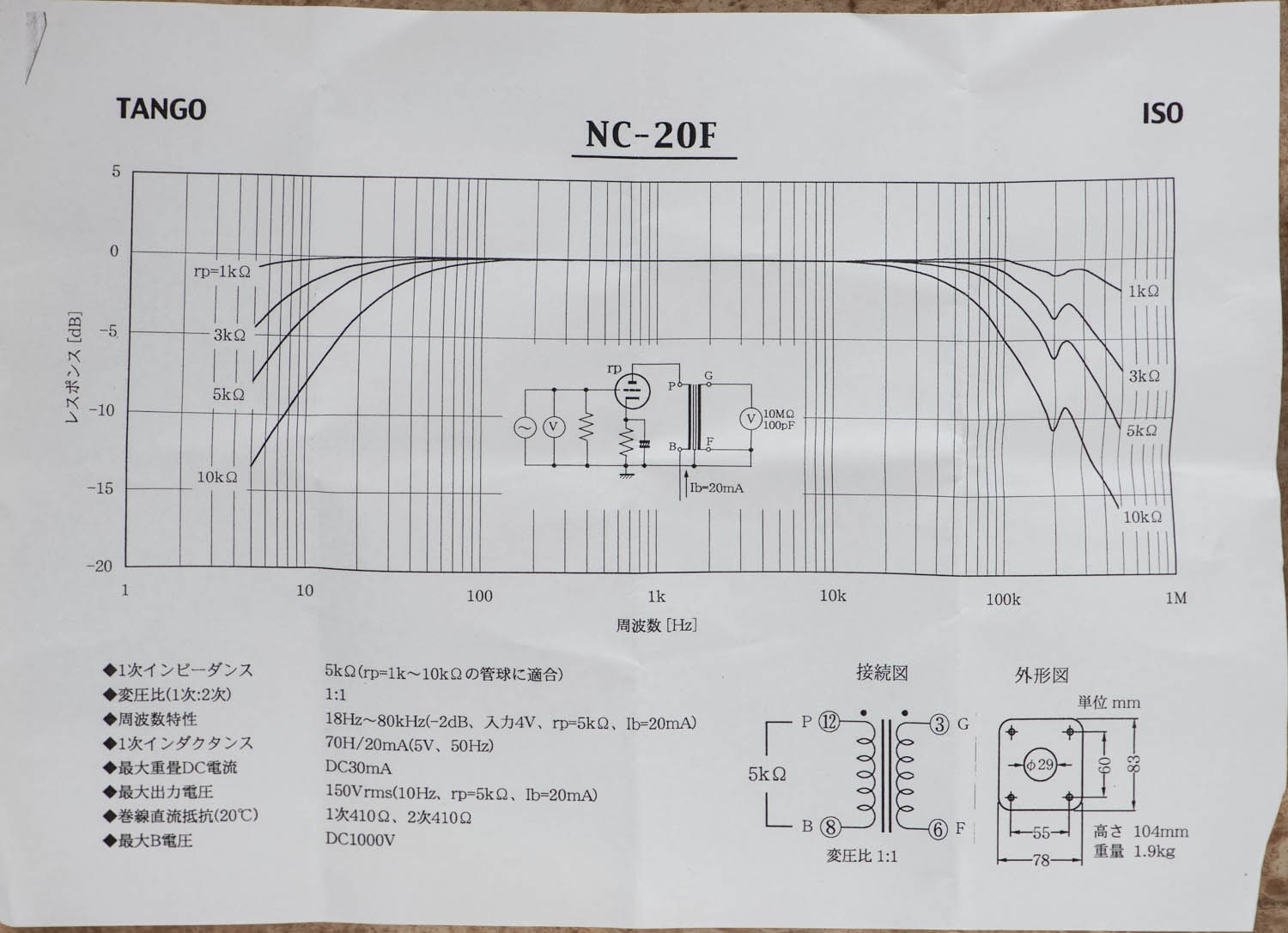
Like all Tango transformers, the NC20 was delivered with a very good data sheet:


Other famous and popular interstage transformers are the NC14 and NC16:


The Hirata versions were offered in hammer tone grey or white.


Both have split primaries and secondaries which can be wired in series or in parallel. This offers many different uses. The NC14 is meant for use with tubes with lower plate resistance. The NC16 for higher rp tubes and it is a 1+1:2+2 while the NC14 is 1+1:1+1. When used with low rp tubes the NC16 could even be wired 1:4. These interstages came in the same small housing like the M757.

It is not clear why these are marked as input transformers. Although they can be used as such, their main application is interstage transformer with DC on the primary. There are 'real' input transformers as well, like the NN-6:


Lineoutput transformers, here the NP8 as used in my UX201A Sound Processor:


Besides transformers Tango also made a variety of chokes:


Yet another different label on these:


Among my favourite Tango products is the EQ600P which contains an entire 600 Ohm LCR network:


These came in the same housing as the NC14 and NC16 transformers. I only saw the EQ600P in white. Besides this there is also the EQ2L, which just contains the 1.8Hy and 45mHy coils. The resistors and capacitors had to be added externally. The EQ2L is a bit shorter in size. Here the EQ600P and EQ2L in comparison:


There had been many more types as those shown here. Of course a whole range of push pull output transformers, more interstage transformers, a MC step up, many different chokes and also power transformers.

There are indications that the brand will be carried on by a new company, but details are not available. If the same types will be produced with the same winding techniques or if just the brand name will be bought is not known yet. With my stock I can offer amplifiers with Tango transformers for a few more years.

But what is the alternative when the stock is used up? There will certainly be a life after Tango. There are other manufacturers who offer the same and maybe even better quality (albeit at a price). I already stocked some alternatives. The company Hashimoto has developed a line of transformers which pretty  much resembles part of the Tango range. In fact most of their transformers match the Tango models in specs and size remarkably close. Their A-305 interstage transformer for example seems to be a promising replacement for the NC20:


The Hashimoto is shown on the left and the NC20 on the right. Finish of the housing is perfect on these. Here the connection terminal:


Another japanese transformer manufacturer with a great reputation for excellent sound quality is Tamura. They offer a wide range of products at different price levels. Here a single ended output transformer:


The build quality of these is exquisite, but comes at a price. They recently introduced a budget range with flying leads instead of a connection terminal:


Tamura is famous for their amorphous core transformers. I have never been too fond of amorphous cores, but I will give these a try:


These also have exceptional build quality and a beautiful finish:


I will build some amplifiers with these various alternatives during this year and evaluate the sound differences.

I would like to thank Mr. Iwasaki, president of ISO-Tango and his entire staff for the marvellous products they made for the tube audio community during the last decades and especially for their commitment to quality and performance. The audio world would be poorer without Tango.

Best regards

Thomas

Friday, October 4, 2013

New Power Transformers - Neue Netztrafos

Hi!

It is has been a while since I presented my line up of power transformers. Since then I added 5 new models for different applications. I also added some transformers with center tapped secondaries since many people asked for them. Here is the line up.

Es ist schon eine ganze Weile her, seit ich meine Netztrafos vorgestellt habe. Inzwischen gibt es 5 neue Varianten, für verschiedene Anwendungen. Es gibt jetzt auch Netztrafos mit Mittelabgriff auf der Sekundärwicklung, da ich öfters Nachfragen für solche Transformatoren bekommen habe. Hier jetzt die ganze Trafo-Palette:


The older models are in the second row. All data for these can be found in the first transformer post.
The new models in the front row share the same general characteristics: Grain oriented cores, vacuum varnished, double screening, outer flux band, tapped primary for 220/230/240V. Models for North America also available (115/120/125V).

Die älteren Modelle sind in der hinteren Reihe. Alle Daten dazu sind in dem ersten Trafo-Artikel zu finden. Die neuen Modelle haben den selben Grundaufbau: Kornorientierte Bleche, vakuumgetränkt, doppelter statischer Schirm, Fluxband, Primäranzapfungen für 220/230/240V.


Transformer for 211/845 amps - Trafo für 211/845-Verstärker

The first transformer on the left is meant for 211 or 845 amps. For these it needs to be used with a bridge rectification scheme. It has 3 separate 6,3V heater windings to supply the heaters of a bridge consisting of 4 TV dampers. The heater windings are brought out as isolated wires. The secondary voltage is 525-500-475-450-0-450-475-500-525V/300mA.
This allows the selection of a secondary voltage from 900 up to 1050V in 25V steps. If the same tap is used on either side of the winding, the center tap can be used to derive half the voltage from the main output, for example to power the driver stage. Of course the transformer can also be used with a center tap rectifier scheme for other purposes. This transformer is a big beast. It barely fits under the 150mm transformer cover.

Der erste Trafo vorne links auf dem Foto ist für 211 oder 845 Endstufen gedacht. Für diese Anwendung muss eine Graetzbrücke als Gleichrichter verwendet werden. Dafür gibt es 3 separate 6,3V Heizwicklungen um eine Brücke aus 4 TV-Damper-Dioden zu heizen. Die Heizleitungen sind als isolierte Drähte rausgeführt. Die Sekundärspannung beträgt: 525-500-475-450-0-450-475-500-525V/300mA.
Dies erlaubt Sekundärspannungen von 900 bis 1050V in 25V Schritten. Wird jeweils die gleiche Anzapfung an den beiden Enden verwendet, so kann vom Mittelabgriff eine zweite Spannung abgeleitet werden, die die Hälfte der Hauptspannung beträgt, z.B. für die Treiberstufe. Der Trafo kann auch in einer Gleichrichterschaltung mit Mittelanzapfung verwendet werden, für andere Endstufen. Dieser Trafo ist ein ziemlicher Brocken. Er passt gerade so unter die 150mm Trafohaube.


Transformers with center taps for 45 / 2A3 / 300B amps - Trafos mit Mittelanzapfung für 45 / 2A3 / 300B Verstärker

The next two transformers in the front row are meant for 'classic' tube rectifier power supplies and can be used for amps using 45, 2A3, 300B or other similar tubes. They have a high voltage secondary 400-350-300-0-300-350-400V and two heater windings. A 6,3V winding for signal tubes and a 0-5-6,3V winding for the rectifier. A 5V tap was added to enable the use of classic rectifiers like 5U4, 5R4, GZ34, GZ37, etc.The 6,3V tap can be used with TV Dampers like 6AX4, 6AU4. There are two versions, which differ in the current rating: The larger one has a 300mA high voltage secondary. The 6.3V heater winding can supply 7.5A. The rectifiers heater winding is rated at 3A for both. The smaller transformer has a 150mA high voltage secondary and 5A heater winding. All currents are the AC rating. Both versions fit under the 150mm transformer cover. The smaller one of the transformers is a little bit too high so that the 120mm cover does not fit.

Die nächsten beiden Trafos in der vorderen Reihe sind gedacht für Verstärker mit klassischem Röhrengleichrichter. Verwendbar z.B. für Eintakt-Endstufen mit 45, 2A3 oder 300B. Die Hochspannungswicklung ist ausgelegt für: 400-350-300-0-300-350-400V. Es gibt zwei Heizwicklungen. Eine mit 6,3V für Signalröhren und eine 0-5-6,3V Wicklungen für Gleichrichter. Eine 5V Anzapfung wurde vorgesehen für klassische Gleichrichter wie z.B. 5U4, 5R4, GZ34, GZ37. Die 6,3V Anzapfung ist für TV-Damper gedacht wie 6AX4 oder 6AU4. Es gibt zwei Ausführungen, der größere Trafo liefert 300mA auf der Hochspannungswicklung und 7,5A auf der 6,3V Heizwicklung. Die Gleichrichterheizwicklung ist auf beiden Trafos für 3A ausgelegt. Beim kleineren Trafo kann die Hochspannung 150mA liefern und die Heizung 5A. Die Angaben beziehen sich jeweils  auf den entnehmbaren Wechselstrom. Für beide Trafos ist die 150mm Haube passend. Der kleinere Trafo ist ein klein wenig zu hoch um unter der 120mm Haube genügend Platz zu finden.


Transformer for use with bridge rectifier for 45, 2A3 or 300B amps - Trafo für Anwendungen mit Graetzbrücke für 45, 2A3 oder 300B Verstärker

The next transformer in the row got developed for use in 45, 2A3 or 300B amps. It is meant to be used with a bridge rectifier with 4 diodes. The secondary arrangement follows a similar approach as my older transformers. It allows secondary voltages to be selected in steps of 25V from 100 up to 400V. The current rating is 300mA. It has two heater windings 6,3V/6A each. One to be used for the rectifier bridge and the other for signal tubes. For this transformer the 120mm cover is the right size.

Der nächste in der Reihe wurde für die Verwendung in 45, 2A3 oder 300B Verstärkern mit Brückengleichrichter (4 Dioden). Die Anordnung der Sekundärwicklungen ist ähnlich zu meinen anderen Modellen und erlaubt Sekundärspannungen von 100 bis 400V in 25V Schritten. Der entnehmbare Wechselstrom beträgt 300mA. Der Trafo verfügt über zwei getrennte 6,3V/6A Heizwicklungen. Jeweils für die Gleichrichterbrücke und Signalröhren. Für diesen Trafo passt die 120mm Haube.


Filament transformer for 211 / 845 - Heiztrafo für 211 / 845

The last of the new transformers is meant for DC filament supplies for 211 or 845 tubes. One transformer is needed per tube. It has a secondary which can be configured in 1V steps from 1V to 20V. The current rating is 5A. It can be used with choke input filters. The voltage is sufficient to reach 10V at the filament with a LCL filter configuration with two Lundahl LL2733 filament chokes. It fits under the 120mm cover.

Der letzte der neuen Trafos ist gedacht für die DC-Heizversorgung von 211 oder 845 Sendetrioden. Es wird ein Trafo pro Röhre benötigt. Die Sekundärwicklungen können für Spannungen von 1-20V verschaltet werden, in 1V Schritten. Es können 5A Wechselstrom entnommen werden. Mit diesem Trafo kann auch eine Heizung mit Drosseleingansgfilter aufgebaut werden. Die Sekundärspannung ist ausreichend  um z.B. eine 211 über ein LCL Filter mit zwei Lundahl LL2733 Heizdrosseln zu versorgen. Die 120mm Haube ist passend.


Send an email if you are interested in any of these transformers (address to be found under the link Impressum/Contact). I will help to select the right transformer for your application.

Bei Interesse an diesen Trafos bitte email schicken (Adresse im link Impressum/Contact). Gerne bin ich behilflich den passenden Trafo je nach Anwendung auszuwählen.


Best regards / Viele Grüße

Thomas

Thursday, May 30, 2013

Lundahl Silver Line Input Transformer Test

Hi!

I am an avid user of the LL7903 microphone input transformer which I like to use as line input, for example in power amps with DHT driver to get some more gain. I like this transformer for its versatility and it's very neutral and transparent sound. After the very positive experience with the silver MC step up transformers, I was glad to be able to convince Per Lundahl to issue the LL7903 as a silver version too.


I just installed a pair LL7903Ag in a 45 power amp with 10Y driver. The amp was shown in an earlier post. The copper transformers got exchanged for the silver version a few days ago. So the new silver transformers had some time to break in, since I used the amp every day. Today I finally gave it a serious listen. I have another amp with the same configuration and parts which I could use for immediate comparison.

During the first comparison a subtle but very noticeable difference was audible. The silver transformers sounded smoother yet retained all the detail. This is a property I like a lot. After listening longer time with the LL7903Ag more pronounced differences got noticeable so that it's not that subtle anymore. This power amp is already the king of tone, yet with the silver input transformers it even improved in that respect. More colours, more vibrant tone. The LL7903Ag improves over it's copper cousin in a similar way as the silver MC step up transformers.

This is not at all sounding like the common prejudices of  'silver sound'. They don't sound 'silvery' at all. It is a very beautiful, smooth, rich and extremely detailed sound.

I still did not have the time yet to try the LL1660Ag silver lineoutput / interstage transformers. If they improve in a similar way over their copper counterparts, the phonostage which I am planning with all silver transformers and silver RIAA coils will be a real treat for the ears.

Best regards

Thomas

Sunday, May 26, 2013

Interstage transformer for a 45 drives 45 amp

Hi!

With my last Lundahl shipment I received samples of a new interstage transformer, the LL2746. This is a 1+1:2+2 interstage transformer on a larger core for high current driver tubes.


The datasheet gives 45Hy primary inductance for the version gapped for 30mA. As most Lundahl transformers this one also can be ordered with different air gaps for various currents. The 30mA version seems just perfect for a 45 drives 45 power amp. With primaries as well as secondaries wired in series it will provide a 1:2 step up ratio which is very helpful since the 45 has very little gain as driver tube. This gives a 6dB boost. Of course the transformer could also be wired as 1:1 when primaries are configured in series and the secondaries in parallel. With the air gap sized for 20-25mA it would also be usable with a triode connected 46.

This interstage transformer is quite big. It comes on a larger core which is also used for small output transformers. Here a size comparison between the LL2746 and the LL1660:


I haven't tried these transformers yet. They will certainly find their way into a future 45/45 amp!

Best regards

Thomas

Sunday, March 24, 2013

MC step up transformer with selectable gain

Hi!

Often people use different cartridges with very different output voltages and impedances. For such situations it is desirable to have a MC step up transformer which can be adapted by switching between different step up ratios.


This is easily doable with transformers with split windings. Lundahl winds all his transformers with dual coils, so both the primary and secondary are composed of two individual windings. The datasheet of the LL1943 suggests two ratios which can be achieved by either wiring the primaries in parallel or in series. Thus allowing either a 1:16 or 1:32 step up ratio.

This can be easily made selectable. All that is needed are two selector switches with 2 poles. One for each channel. Or a single 4 pole switch which would allow to switch two channels at once. The schematic below shows how this is done:


In the schematic the switches are in the position which puts the primaries in series. Thus this represents the lower step up ratio.

A minor drawback of his schematic is the fact that the connection between the two windings goes through two switch contacts in case of the serial position. The next schematic shows how to avoid this:


It is quite easy to assemble such a MC step up. I will show this in a few photos. The RCA connectors, switch, ground connector and transformers are all wired on a metal plate which serves as the back panel:


The second schematic is a bit more difficult to wire but doable. The photo below shows the switch prepared for this:


I cushioned the MC transformers so that the mu metal casing doesn't get bent which would impact it's permeability. A close up showing the mounting of the transformers:


The back panel completely wired up:


A close up showing the wiring to the output jacks:


And a close up of one of the switches at the input side:


Now everything can be assembled into a wooden housing. The front panel holds the bolts to which the back is attached later on. It also gives some weight to the transformer, so it is not too easily pulled from the rack by interconnects:


The finished MC step up:


The back panel:


Best regards

Thomas