
This months tube is another favorite rectifier. When you read my blog, you probably realized already that I'm not a big fan of the 'classic' tube rectifiers like 5U4, 5R4, etc. My favorites are TV Dampers of which I already presented the 6AX4. In terms of electrical paramters these have all I need. If some more power is required, there are also plenty TV dampers available, like the 6CG3. But sometimes you want something which is more spectacular in terms of aesthetics. If it comes to looks, mercury vapour rectifiers are the way to go. Nothing beats that mystical blue glow of a 866A:

This is a photo taken from a 866A in operation. As the name implies, the tube contains mercury, which get's vaporized during warm up of the tube. When current flows, ionized mercury creates this eerie blue light which is quite intensive. But nothing comes for free, there is a big disadvantage of these tubes: mercury is very toxic and these rectifiers contain lots of it. This article should not be understood as an encouragement to use such tubes. Do so at your own risk. These need to be handled very carefully and all necessary precautions need to be applied to avoid breaking of the glass.
866As have been manufactured by many suppliers. Many are still available in NOS quality. Probably the most from the famous company RCA.

The 866A has more disadvantages over conventional rectifiers. They are single diodes. This means for the classic full wave rectifier scheme 2 of them are needed. A bridge requires even 4. The 866A has some hefty filament requirements: 2.5V, 5A for each tube. But therefore it can supply a lot of current. 250mA average per tube which translates to 500mA DC from a pair of them in a full wave rectifier. At lower voltages (peak inverse voltage below 2500V) this value can even be doubled.
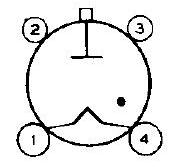 It has the UX4 base like most of the directly heated triodes. Only 2 of the 4 pins are used. The filament is brought out to pins 1 and 4, the two other pins are not used. The plate connection is brought out to a medium size cap at the top. Besides the care which is necessary to avoid the risk of breakage, the operation is also a bit tricky. The filaments must be warmed up for 30-60 seconds before the plate voltage is applied. This is necessary to ensure that the mercury is vaporized. Otherwise small drops of mercury could create an internal short and arc overs which would damage the tube. When a mercury vapour tube is used the first time, or after it has been transported, it needs an initial warm up time of 30 minutes without plate voltage. After that, and if the tube remains in it's socket in vertical position with the base down (which is the only way it is allowed to be operated in) 30-60 seconds warm up for each consecutive turn on cycle are sufficient. A complete datasheet can be found here. I already wrote about an amp with a PSU using 866As. Details can be found in the post about a 6CB5A amp with 866A rectifiers. This article also explains a possible method to provide a delayed high voltage to ensure proper warm up time.
As mentioned above, the 866A is still very well obtainable. Mostly with the ST shape bulb which has the same size as a 300B. Much rarer is the earlier globe type 866. Here a photo of such a version from RCA which was packaged in gorgeous boxes with a map of the world printed on them:

Here another 866A in ST glass and with brown micanol base, manufactured by Taylor. Note the careful padding which was applied to avoid damage during transportation:

A small selection of 866As from different suppliers:

The last photos show some early work of mine with 866A tubes:

A fascinating tube! If you want to avoid the mercury but would like to have the same looks (except the blue glow) there is a near equivalent vacuum rectifier, the 836, which will be covered in a future tube of the month article.
Best regards
Thomas

Nice photo of the world map, really beautiful. Do you make your own plate caps or do you use NOS?
ReplyDeleteHi J!
ReplyDeleteI mostly use plate caps from current manufacture
Thomas
I want to put an old Elmac 67 transmitter on line, and will be building its power supply.
ReplyDeleteI want to use rectifiers that glow when operating, like mercury vapor. I can remember the first ham station I visited, and was impressed by the glow from the various cabinets, that fluctuated with modulation. I would like to get a little of that back, and in my shack. (My solid state equipment just sits there with no action.)
I will be running a maximum of about 120 mills, at 120 hz. I’m thinking of having a full wave solid state bridge feeding the tube in order to maximize the glow from the tube. This is strictly for show.
Can you give me some pointers as to which tubes will give me the brightest glow from this application?
Do you have any in stock, and what are the pricings?
Thank You,
Bernie KE7XD
amsandbjs@gmail.com
Hi!
Delete866A or 816 would work. Check prices at the usual tube dealers. These are easy to find
Best regards
Thomas
Any prefference on brands?
ReplyDeletehi Thomas,
ReplyDeleteI 'm building 211 Amp. i have used 866A as PS.
i hope you can give me advise to me.
how configuration filament of 866A? My filament PT 2.5V - 0 -2.5 V ac / 14A
i apply 866A x 2 as series (5Vac) and center tap as B+.
Are That wrong? and must be pararel ?
Thank you.
best regards
ed
Hi! You can wire them in series. Check that the filament voltage splits evenly between the tubes. A 14A transformer might give too high voltage if loaded with 5A. Then drop with resistors. Why not get the appropriate transformer for such a project?
DeleteThomas
Thank you for your answers.
DeleteI can be quiet for used that.because I have not experienced with it.
I have wrong to write . I mean this transformer is 0 - 2.5 Vac /7A x 2 and i make 2.5 Vac - 0 - 2.5Vac for get Center Tap. before i will use for parallel. but seeing that I was more than good with the configuration of the CT because it provides balance (I do not know whether this is true in my opinion).
I learned a lot from your posts here. thank you very much to you that many share knowledge.
Thank you.
best regards
ed
Hi!
DeleteIf you have two separate 2.5V windings you will have no problem with the voltages splitting equally. There is no advantage in connecting them the way you do, but also no harm. You can also simply connect one side of both heater windings to the B+ filter chain. The RCA manual states a preferred pin from which to take the B+
Thomas
hi,
ReplyDeletein the manual of the RCA is parallel.
I searched the internet and have not found a series configuration. so I hesitated. but with your explanation I became confident with it.
Thanks a lot .....Thomas.
Best Regards
ed
Don't really need the nanny-state stuff on mercury. In the first place, the oxides of mercury are harmful, not so much the metal. Also, is anyone thinking of opening a tube and consuming it? If not, don't worry about the mercury.
ReplyDeleteI did a bit of homework in PSUD for a 250mA/350VDC application. My transformer needs a choke input to get there as it has only 290VAC.
ReplyDeleteSo, when I simulated it with a 30uF input cap and a following 8H/40Ohm choke: the peak current stays still comfortably below the 1A peak current, it looks all good, even with only 30Ohm on the secondary !
Now, can I trust these values ?
I have read mutiple times that you have to be extremely careful when going cap input on Mercury Rectifiers. Found this nice article https://www.die-wuestens.de/iz/RECT.pdf where they specified Rt=350*1.57/1 for my example...Rt more than 500 Ohm ??? PSUD gives me completely different picture...
If you are unsure if you can trust your own simulations, why not simply get the right power transformer and use these tubes with choke input as they are intended to be used? Power transformers are not that expensive. And it would give a much better power supply
DeleteThomas, I am finishing up a PS of your design for my 300b amp. I used a lundahl xformer to get the 550 a vintage utc for the split 2.5 10A and two 10H Lundahl chokes with 80 uf in between as you have designed it. I went thru two 866a's and a 1616 pretty quick before getting to pairs of each that have continued to work. The failures seem to be because of their age?, - not much more i could do, I gave each tube a generous warm up period before bringing on the B+. I've noticed a difference in volt drop between the 866a and the 1616 can you confirm this for me. The B+ came in at 423v. To get up to the target 445-50v for my 300b amps i've put a .85uf cap across the first choke which brought the voltage up 23volts. any suggestions. I'll share some pics soon. best wishes, David
ReplyDeleteHi!
DeleteThere cold be various reasons for the failures of the tubes. Difficult to say without thorough analysis what is going on. 1616 is a vacuum rectifier which has higher voltage drop than MV tubes.
Thomas