
This month lets have a look at yet another TV damper tube, the 6W4.

The 6W4 it quite interesting since it is the very first tube which was specifically developed for TV damper service. Prior to the 6W4 regular rectifiers were used for this purpose, but this application requires very high voltage and peak current capabilities which called for specific tubes. For a little more back ground information about TV dampers see my post about the 6AU4.
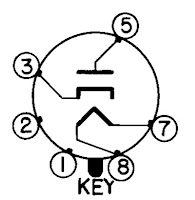 For the 6W4 the pinout of Octal based TV dampers was defined which was then kept the same for all later Octal dampers like the 6AX4, 6AU4, 6DE4, and all others. Although the voltage and current ratings of the 6W4 are modest compared to the later TV damper tubes, they are quite impressive for the time of it's introduction. 3850V maximum peak inverse voltage, 750mA peak current. See the General Electric datasheet for all technical parameters. In the early data sheets the parameters for rectifier service are given as well. For rectifier usage it still lists a PIV of 1250V and even a max value of 20uF for capacitor input filters. The DC current for a pair of 6W4 is given as 250mA. This gives a good indication how the parameters of other TV dampers should be derated for rectifier service. In later data sheets
 the use as rectifier is not recommended, but that was a pure marketing move since tube manufacturers wanted to keep selling their expensive, dedicated rectifier tubes. Yet this didn't hold back clever amplifier designers to use TV dampers in their power supplies. A good example is Marantz which used the 6AU4 in one of their amps. Some early TV sets also used 6W4 tubes as rectifiers in the power supply. The 6W4 was availed with two suffixes: 6W4GT and 6W4GTA. The A version has a more controlled heater warm up time and is interchangeable with the earlier type. The 6W4 is very well usable in most applications in which the 6AX4 will do. The lower voltage ratings should be observed, especially the lower heater to cathode voltage ratings. So this is yet another nice alternative for power supplies. Like other TV dampers this tube is available in abundance and is cheap.

Let's start with the 6W4GT made by National Union.


Close ups showing the heater wire extending out of the cathode at the top and bottom:


The 6W4 already has the typical look of all the later, more modern TV dampers.

Emerson 6W4-GT:


General Electric:


Sylvania made lot's of 6W4 tubes.


Different style packaging:


An older version:


This one has almost half the glass covered with getter:


A later Sylvania branded 6W4:

Some close ups:


This one looks suspiciously similar to the first General Electric shown above.

And indeed their internals are identical.

Another example of the cross branding which was very common.
Zentih:

Like most Zenith tubes this one appears to be made by Sylvania.


This Tronal 6W4GT came in a plain white box.


Nice large bottle.

And quite nice internal construction details


'TRU-VAC':

Appears to be made by Sylvania.


Zalytron:


Looks a lot like the Tronal branded one above.

Mullard:

Made in Italy.


Stromberg-Carlson was an equipment manufacturer and branded tubes made by others.

Philco, another equipment manufacturer who sourced the tubes from Sylvania.


Channel Master:


DuMont:


ITT made in Japan:


CBS-Hytron:


Realistic, another rebrander:

Akrad 6W4GT branded by a parts supplier:


Motorola:

Selectron:


Triad:


Tung-Sol:


RCA of course also made many 6W4.


RCA in military packaging:


Rad-Tel:


Westinghouse:


Westinghouse in military box:


At first sight there seems to be no getter. It is all the way down hidden in the base:

Close up to the top:

And lastly Raytheon:


As is typical for Raytheon tubes these also have nice internal construction:


We haven't had a tube dissection in a while, so lets crack this one open:

Removing the glass:

The getter ring at the top:


Nicely shaped plate for lots of cooling area:

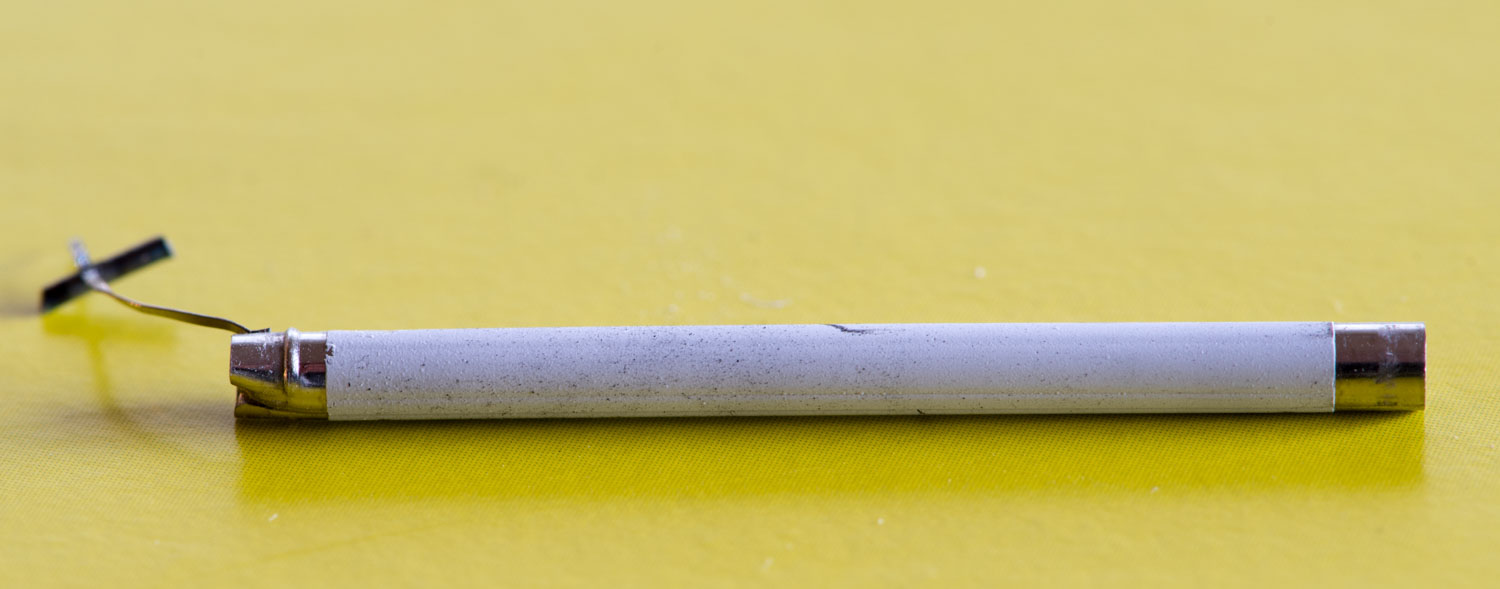
Pulling the heater wire out of the cathode sleeve:

While most TV dampers use a spiral between heater and cathode for insulation, this one has ceramic beads to keep the heater wire at a certain distance.


The cathode:

And now let's close this tube of the month post with some 6W4 glowing away.


A Raytheon 6W4 in operation:


A Sylvania:

GE:


I guess I got carried away again with many photos for this post, which shows my passion for TV dampers. I hope you enjoyed it.
Best regards
Thomas


