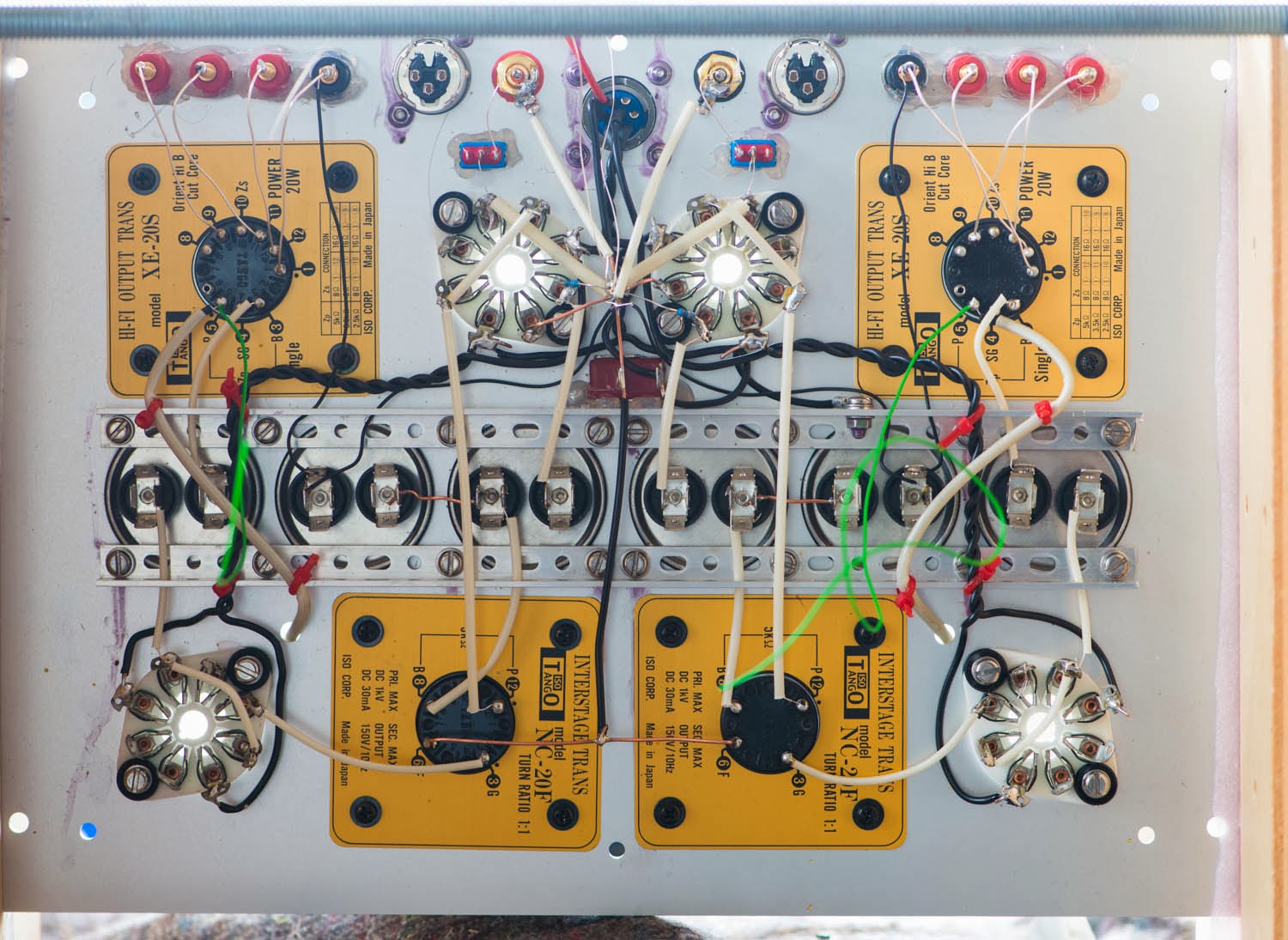
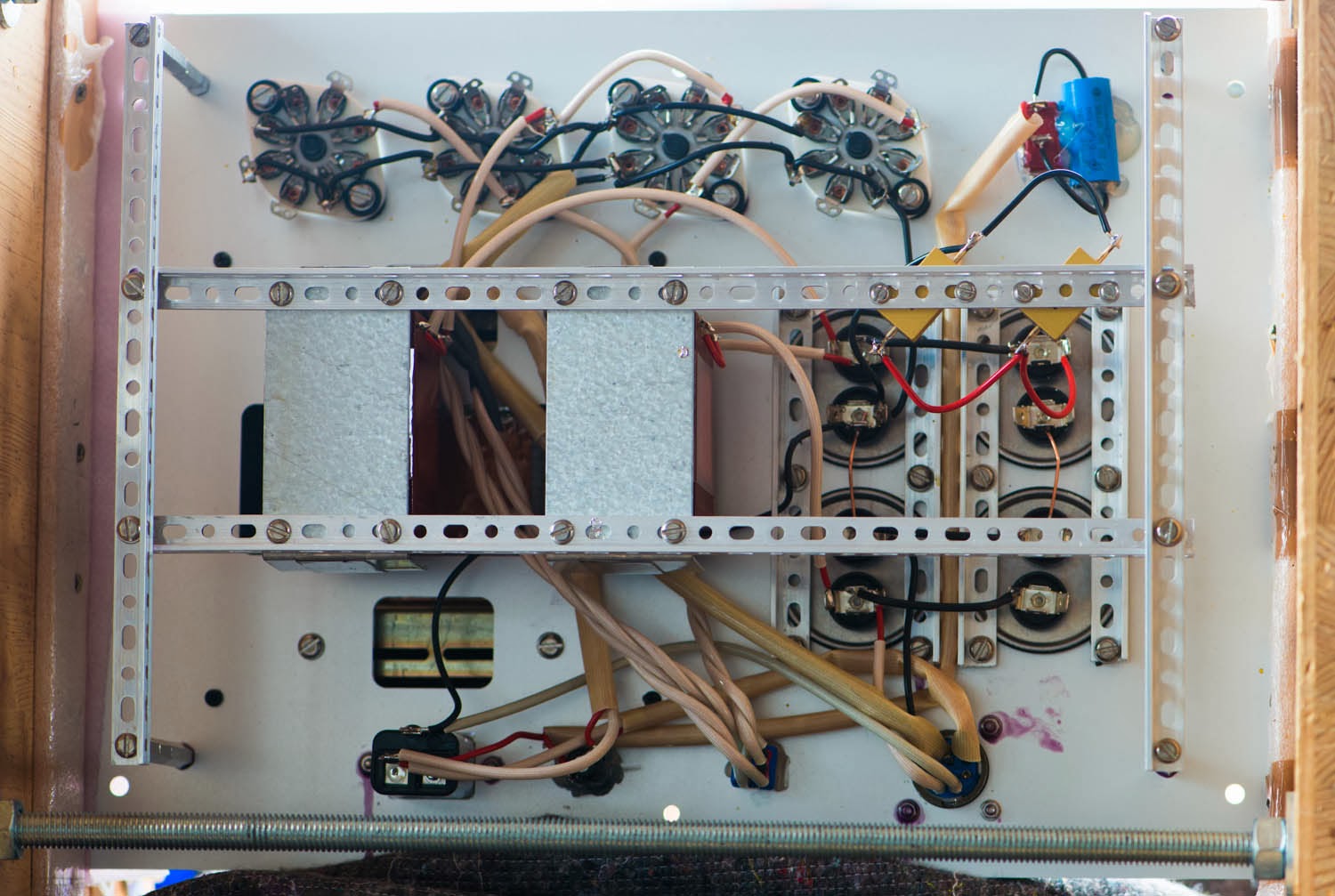
Hi!
After I published the recent posts about the integrated and no compromise single ended 6CB5A amplifiers, I got many questions about the difference in sound between them and how the 6CB5A holds up against a 300B.
If you are a regular reader of my blog and followed the article series 'How does it sound' parts 1, 2 and 3 (also translated to german: 1, 2, 3) you already know that I am a bit reluctant to give sound impressions since they are always subjective and only valid within the context the evaluation has been done. Anyways I understand the wish to get at least some impressions about the sound of an amp people read about in the internet.
So I did a comparison between the two recently shown 6CB5A amplifiers which represent two ends of the scale in terms of parts quality and circuit topology for this concept. At least the way I have built these so far. There are always ways to improve certain aspects. Also the integrated amp could even be made a bit cheaper. But as built these two amplifiers represent what I think is feasible and makes sense. Even my entry level amplifiers shall have the basic sound qualities which I want and which are described in the articles linked above.
The integrated amplifier is in no way cheap sounding. It has a wide frequency spectrum and especially surprisingly solid bass. All the tone colours and details in the sound reproduction which are important to me are there. The power amp section has the same sound characteristics as the 6CB5A mono amplifiers which I showed earlier this year. Also the preamp section does not disappoint although it shares the power supply with the amp. The sound character of the Octal Phono and Line preamplifiers are retained.
The integrated amplifier is very quiet also through the phono input. The external power supply avoids any hum injection into the phono section. And it has another great advantage: No more worries about all those interconnects and their potential negative impact on the sound. Take this with a grain of salt since I am not that much into cable sound. But for people who suffer from 'nervosa audiophilia', this would be one aspect less to worry about. Only interconnects to the turntable and CD Player are needed and speaker cables.
In order to do a valid comparison between the two amplifiers, I listend to the no compromise version using the line outputs of the integrated amp. I would normally recommend to use this amplifier with a preamp which is further up in the hierarchy of my scale, like the Octal Preamp MK2. Still this comparison quickly revealed the differences between the amplifiers. Although the more elaborate amplifier does not measure as wideband as the integrated amp (this is due to the transformer coupling) it has audible better resolution especially in the frequency extremes. Small shadings in tone colours in the bass are better reproduced and the highs are clearer, voice articulation is more natural. General tone colours are stronger and small differences in sounds like vibrations in frequency and amplitude are better resolved. All these differences become more pronounced when the no compromise amp gets hooked up to a better preamplifier like the mentioned Octal preamp Mk2 or a LCR phono stage.
So it is a matter of available budget and size constraints which amplifier to choose. I like them both for what they do and how they sound given the effort spent. I had been using the integrated amplifier as my main amp for a few weeks now and I could happily live with it. As I already mentioned in the past: An easy way to get good sound is to be happy with what you have or what you can afford. And stopping to worry if it could be better and what should be changed to get better sound. At the end it's about music and in reproducing music, both do an excellent job.
And how about the sound compared to a 300B? This is a question I get often lately, how does the 6CB5A compare to a 300B? My standard answer is that this question does not make sense in isolation. It is never the output tube alone which determines the overall sound. Much more important is how it is used and with which components and circuitry.
When I am asked I typically ask back: Compared to which 300B? I have heard larger differences between different 300B tubes than between a certain 300B and a 6CB5A. For me the 6CB5A is the alternative to the 300B if budget is restricted and original Western Electric 300B are not available. Even compared to new production 300Bs the 6CB5A are so much cheaper that this leaves more budget to use good quality components like the transformers used here.
So it is all a matter of taste, preferences and budget. If you think you have to have a 300B, by all means use it. It is a great tube. But it got so much hype during the last decade which is not really justified. Don't think by just using a 300B you will get the best possible amplifier. Done right and using the best 300B tubes, a SE 300B sounds marvellous. I have built with the 300B in the past and will build with it in the future. If you are more concerned with the overall concept and best possible sound within a given budget, there might be alternatives.
Best regards
Thomas
DISCLAIMER
All rights of photos and text reserved. Usage of photos or text from my blog on other websites or for any other purpose only with prior permission. If you want to use any material from my blog please contact me by email.
Tuesday, November 12, 2013
Friday, November 8, 2013
UX201A Sound Processor, Part 2 : Assembly
Hi!
After the presentation of the circuit in part 1 of the article series about the UX201A Sound Processor, this post will show the assembly steps.
Since this circuit needs massive heatsinks, the usual chassis with wooden frame would not work. So I designed a completely new full metal chassis style. The chassis was sized as compact as possible.
The top metal plate with sub plates for the tube sockets:
The sub plate mounted into the main plate:
Pre assembled main plate:
Adding the Tango NP8 line output transformers. The connection between transformers and plate pins are already in place (done with solid core silver wire and additional insulation sleeve):
Preparation of the heatsinks:
The 3 resistors on the left side are 1.5k/25W types. They will be wired in parallel to get the 500 Ohm resistor through which the filament voltage is derived from B+. It has been split into three resistors to spread out the heat dissipation. The resist on the right is the 22 Ohm filament bias resistor.
Mounting the heatsinks to the top plate :
Wiring of the resistors. The main ground buss is also in place already (wire at the bottom):
Adding the chokes :
The chokes are nice nickel core units wound for me by Dave Slagle
View from the backside before the panel with the connectors is attached:
Preparation of the back panel:
There are two sets of outputs. The NP8 secondary has a tap for extra low output impedance.
Backplate attached to the Sound Processor:
Adding the bottom plate :
Finished:
In the next articles the circuit and assembly of the power supply will be covered. Stay tuned!
Best regards
Thomas
After the presentation of the circuit in part 1 of the article series about the UX201A Sound Processor, this post will show the assembly steps.
Since this circuit needs massive heatsinks, the usual chassis with wooden frame would not work. So I designed a completely new full metal chassis style. The chassis was sized as compact as possible.
The top metal plate with sub plates for the tube sockets:
The sockets are mounted to sub plates which in turn get attached to the main plate by rubber damping elements as seen in my DHT preamps and phono stages.
The sub plate mounted into the main plate:
Pre assembled main plate:
Adding the Tango NP8 line output transformers. The connection between transformers and plate pins are already in place (done with solid core silver wire and additional insulation sleeve):
Preparation of the heatsinks:
The 3 resistors on the left side are 1.5k/25W types. They will be wired in parallel to get the 500 Ohm resistor through which the filament voltage is derived from B+. It has been split into three resistors to spread out the heat dissipation. The resist on the right is the 22 Ohm filament bias resistor.
Mounting the heatsinks to the top plate :
Wiring of the resistors. The main ground buss is also in place already (wire at the bottom):
Adding the chokes :
The chokes are nice nickel core units wound for me by Dave Slagle
View from the backside before the panel with the connectors is attached:
Preparation of the back panel:
There are two sets of outputs. The NP8 secondary has a tap for extra low output impedance.
Backplate attached to the Sound Processor:
Adding the bottom plate :
Finished:
In the next articles the circuit and assembly of the power supply will be covered. Stay tuned!
Best regards
Thomas
Tuesday, November 5, 2013
No compromise 6CB5A amplifier
Hi!
After the recent 6CB5A projects which had been attempts to keep the budget down, as in the low cost version, or to keep the size small as in the integrated amplifier, I just completed an all out, no compromise power amplifier with this tube.
This is an upgraded version of a stereo 6CB5A amp which I presented last year. It has an external power supply in a separate chassis and uses more elaborate decoupling of the supply voltage to the driver stage, which now got it's own choke per tube. The power supply uses an all tube bridge rectifier instead of the hybrid arrangement.
It uses Tango input and output transformers. This might be the last 6CB5A amp which I have built with Tango transformers since ISO Tango stopped production recently and it is not clear if they will get back into business again.
As is adequate for such a no compromise amplifier, all signal wiring is done with solid core silver.
Four Lundahl chokes in the amplifier section for extensive decoupling of the power supply voltage.
The finished amplifier section in the assembly rig:
Amp mounted in the wooden frame, and powered up for a first listen:
The PSU is a bit less crowded inside, the first wiring layer:
Two chokes added in another tier:
The PSU mounted into it's wooden frame:
As a special touch, two vintage panel meters are inserted into the front. The left one shows the B+ voltage and the right one the current draw of the amplifier.
Some other specialities which this amp got:
In addition to the standard single ended inputs, this amplifier is equipped with a set of input transformers for a balanced input option which can by selected by the switches.
The power supply has been made configurable so that it can either supply the 6CB5A amplifier section or a stereo 2A3 amplifier:
This is done with a simple switch at the back which selects different taps of the power transformer secondary:
This amplifier shows again what a marvellous tube the 6CB5A is. Although the recreantly lower cost implementations sound very nice and enjoyable, this implementation is in another league.
Very smooth, yet detailed sound. Especially the Tango NC20 interstage transformer contributes to this result, which can also be seen in the measurements which show an extended frequency response without any resonance peaks.
Again the 6CB5A has proven that it can easily compete with directly heated triodes. It is my favourite indirectly heated output tube.
Best regards
Thomas
After the recent 6CB5A projects which had been attempts to keep the budget down, as in the low cost version, or to keep the size small as in the integrated amplifier, I just completed an all out, no compromise power amplifier with this tube.
This is an upgraded version of a stereo 6CB5A amp which I presented last year. It has an external power supply in a separate chassis and uses more elaborate decoupling of the supply voltage to the driver stage, which now got it's own choke per tube. The power supply uses an all tube bridge rectifier instead of the hybrid arrangement.
It uses Tango input and output transformers. This might be the last 6CB5A amp which I have built with Tango transformers since ISO Tango stopped production recently and it is not clear if they will get back into business again.
As is adequate for such a no compromise amplifier, all signal wiring is done with solid core silver.
Four Lundahl chokes in the amplifier section for extensive decoupling of the power supply voltage.
The finished amplifier section in the assembly rig:
Amp mounted in the wooden frame, and powered up for a first listen:
The PSU is a bit less crowded inside, the first wiring layer:
Two chokes added in another tier:
The PSU mounted into it's wooden frame:
As a special touch, two vintage panel meters are inserted into the front. The left one shows the B+ voltage and the right one the current draw of the amplifier.
Some other specialities which this amp got:
In addition to the standard single ended inputs, this amplifier is equipped with a set of input transformers for a balanced input option which can by selected by the switches.
The power supply has been made configurable so that it can either supply the 6CB5A amplifier section or a stereo 2A3 amplifier:
This is done with a simple switch at the back which selects different taps of the power transformer secondary:
This amplifier shows again what a marvellous tube the 6CB5A is. Although the recreantly lower cost implementations sound very nice and enjoyable, this implementation is in another league.
Very smooth, yet detailed sound. Especially the Tango NC20 interstage transformer contributes to this result, which can also be seen in the measurements which show an extended frequency response without any resonance peaks.
Again the 6CB5A has proven that it can easily compete with directly heated triodes. It is my favourite indirectly heated output tube.
Best regards
Thomas
Sunday, November 3, 2013
Tube Box Art, Part 14 : Tung-Sol
Hi!
An important brand which was not covered yet in the Tube Box Art series is Tung-Sol. This company developed the 6550 tube which is one of the most widely used output tubes in audio.
Tung-Sol started it's business with the manufacturing of lamps. They were pioneers in car head lights and indicators. In the 1920ies they also started to manufacture vacuum tubes.
Today the brand name is owned by New Sensor corporation.
Two boxes with 46 tubes in boxes with a 'T'-theme:
The top and bottom flaps:
Octal size tube boxes:
Different size boxes:
Box with a wave motif:
Best regards
Thomas
An important brand which was not covered yet in the Tube Box Art series is Tung-Sol. This company developed the 6550 tube which is one of the most widely used output tubes in audio.
Tung-Sol started it's business with the manufacturing of lamps. They were pioneers in car head lights and indicators. In the 1920ies they also started to manufacture vacuum tubes.
Today the brand name is owned by New Sensor corporation.
Two boxes with 46 tubes in boxes with a 'T'-theme:
The top and bottom flaps:
Octal size tube boxes:
Different size boxes:
Box with a wave motif:
Best regards
Thomas
Subscribe to:
Posts (Atom)