DISCLAIMER

All rights of photos and text reserved. Usage of photos or text from my blog on other websites or for any other purpose only with prior permission. If you want to use any material from my blog please contact me by email.
Showing posts with label 26. Show all posts

Monday, January 18, 2016

The Tale of Two Preamplifiers - Part 2

Hi!

In part 1 the story of these two preamplifier was already introduced. In this post I will reveal which tubes got tested and which were the favourites in terms of sound.


The test set up which was used for evaluation was already shown in part 1. An adjustable power supply provided all the necessary voltages for the different tubes.


Operating points are chosen with a couple of switches which selected from an array of resistors for cathode or filament bias.


Pretty much all directly heated triodes with an UX4 base are usable, for example: UX201A, UX112A, 26, 30, 31, 45, 50, 183/483 and 71A. But even indirectly heated triodes like the 27, 37, 56 or 76 could be used with  socket adaptor.


Also the 46 was tested with a socket adaptor which tied grid 2 to the plate.


And in addition two european DHTs. A Siemens Da:


Again to be plugged in via an adaptor:


And the Telefunken RE074:


Also with an adaptor:


The 10Y or 801A were not included since I have separate preamps with these tubes which could be used for comparison. Hopes were very high for the european tubes and also the 45 and 50. But surprisingly none of them turned out to excel in this set up. To be fair, none of the tubes sounded really bad and the differences are rather subtle. After all the overall sound is largely determined by the circuit topology and its execution. One of the winners was not much of a surprise since I was already familiar with it:


The 26 which I already used in a 26 line stage before. It has a very gentle and smooth sound and applies a touch of 'dark chocolate' or 'caramel' flavour to the sound which can be very pleasing. This description is of course an exaggeration for illustration. The effect is rather subtle. The other tube which came out as a favourite and turned out to be even better than the 26 was the 31. A directly heated battery triode.


Shown above as UX231 in tubular shape. The 31 offered a very refined and high resolution sound in this set up. A runner ups in this competition were the 71A and 183/483 which also provided a very clean and impressive sound. Also not bad was the 27. It does not exhibit it the certain magic of indirectly heated triode but is very interesting nonetheless. More about this in an upcoming post.
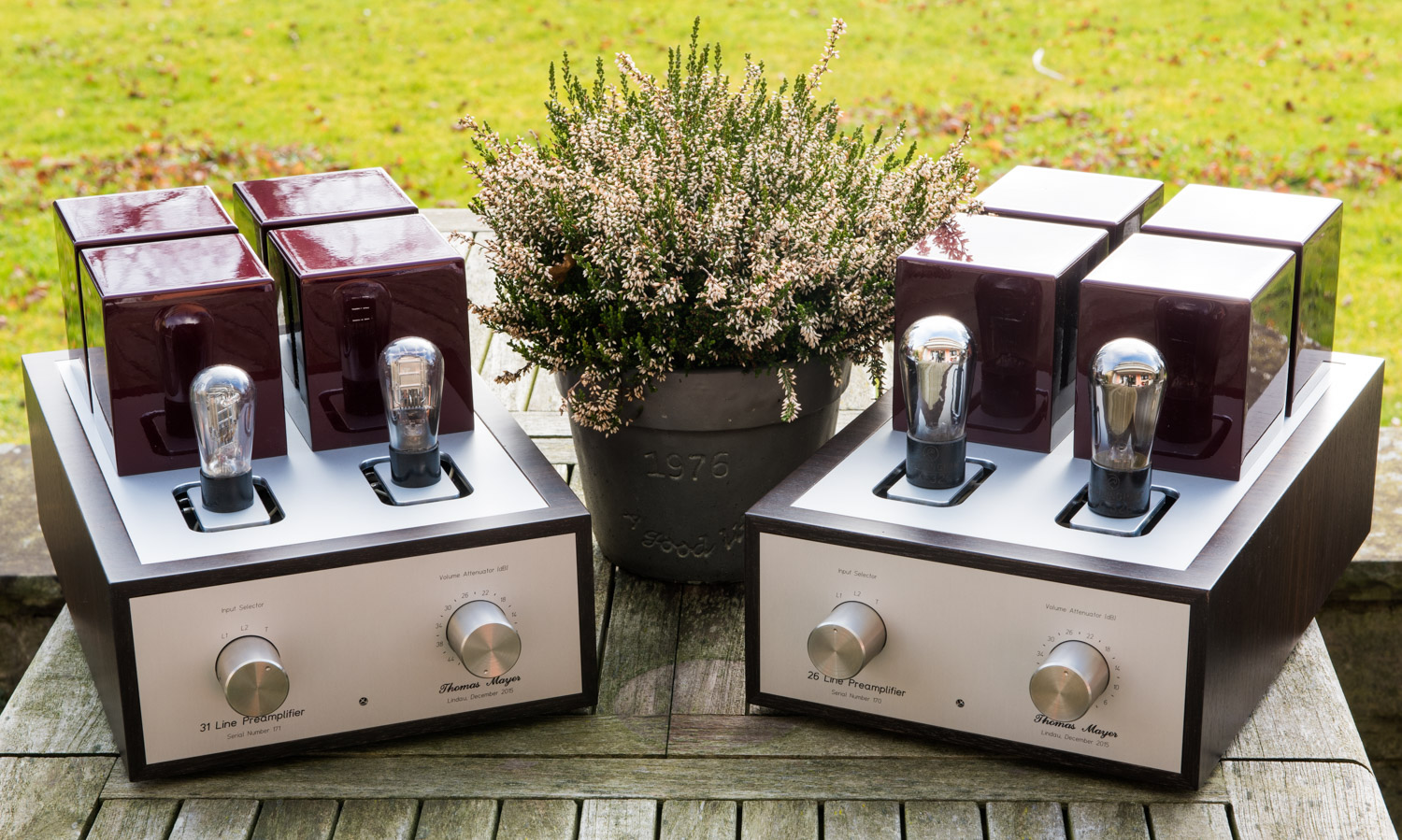


Since the originator of the project could note decide between the 26 and 31, he commissioned two preamps.


Since both tubes run at similar plate voltages, the two preamps can be used with the same power supply. Both tubes run in filament bias. Additional bypass resistors are used in the 31 unit so it can work with the same power supply as the 26 without any switches.


The powert supply uses a full ave bridge with 4 half wave tube rectifiers. But not with 6AX4 TV dampers as usual but this time with a different tube, the 1V. More about this tube in an upcoming post.


Shown above both preamps with the PSU. The back sides:


An interesting project which gave some valuable insights. Thanks again to the originator of this. It has been an interesting journey. I'll ask for some sound descriptions from the owner of these preamps for another part of this story. Stay tuned!

Best regards

Thomas


Sunday, June 14, 2015

The 26 Line Preamplifier

Hi!

In the tube of the month post about the 26 I mentioned that I am working on a preamp with this triode. The preamp has been finished since a while and was playing in my system since then.


Shown above is the signal section with Cunningham CX-326 tubes. The layout is a bit different from my 10Y line stages. This time all chokes placed on the top under transformer covers. There are two filament chokes and two B+ chokes for decoupling of both channels. Since the 26 is perfect for filament bias, this approach is used here.


As usual, the power supply unit has a separate chassis, which contains two independent filament supplies and a common B+ supply for each channel. So another 4 chokes in the PSU and 3 power transformers.


The 26 is a very beautiful sounding tube compared to the 10Y it offers a slightly 'creamy' sound. A tad less resolution but therefore much more forgiving and to some tastes maybe more enjoyable and fun.


The globe tubes even further enhance those characteristics with the sound almost having a 'dark chocolate' flavour. Different ears might perceive this in another way. Although this description might suggest that the 26 has a coloured sound, this is not the case. The overall sound is very detailed and the above is just an attempt to describe the difference to the 10 line stage.


This was a fun project and I am glad that I used the 26 again which I have not used since quite a while. A great tube which has a lot of magic. I hope when he receives it, the owner of this preamp will enjoy it as much as I did during last week.

Best regards

Thomas

Saturday, May 30, 2015

Tube of the Month : The 26

Hi!

This month I am presenting one of the earliest directly heated small signal amplifier tubes, the 26 triode.


The 26 was introduced in the 1920ies as UX226 in globe shape which was replaced by the 'coke bottle' shaped 26 in the 1930ies.

The 26 has an UX4 base with the same pinout as is common for many directly heated triodes. The data sheet  classifies it as AF or RF amplifier tube. It runs at rather low plate voltages of 180V max and at low currents below 10mA, which makes it unsuitable as output tube. The filament operates at a low 1.5V and at 1.05A. With an amplification factor of 8.3 and a plate resistance of about 7-8 kOhms the 26 is quite similar to the UX201A. But it has a very different filament. While the UX201A uses thoriated tungsten, the 26 has an oxide coated filament. Every amplifier builder who experiments with directly heated tubes comes across the 26 at some point. Since it is not suitable as output tube, the natural choice is the use as driver or input tube or as line amplifier tube. There is a long discussion thread on DIYaudio about 26 preamplifiers which is worth checking out. It shows how popular this tube is among DIYers. Commercial amps or preamps which use this tube are pretty much non-existent, which makes this a very interesting field to explore for DIYers.
Although the 26 hasn't been produced since many decades, availability is still good and prices are reasonable. However it needs some care to get it to sound good without noise. The discussion thread linked above will give some insight into this. The low filament voltage might seem tempting to try to get away with AC heating. But you can forget that. It needs very clean DC to operate without hum. Also microphonics and pick up of stray fields might cause some trouble. But once all these difficulties are dealt with it gives a very nice and creamy sound. This tube is a fine example of the magic of directly heated triodes. I have used this tube myself in a 26/801A line stage and as driver for the 45. Due to it's high plate resistance of 7-8 kOhm I prefer to use it with step down transformers in preamps to get low output impedance. The plate resistance limits the use as driver tube to small output tubes like the 45 or 2A3. I'd use something beefier to drive a 300B.  I also have a new line stage in the works which will use the 26. It will be shown on my blog as soon as it is finished.

Looking at it's plate curves shows one of the reasons why this tube sounds so good:


And here a real tube on the curve tracer for comparison:


The 26 was produced by many manufacturers in different styles. Even tubes from the same manufacturer can vary in construction style. RCA probably made most of the 26s out there.


Different style packaging from RCA:


The tubes 'float' inside this package in a clever cardboard insert:


Another style:


The tubes in these different package styles also varied in some details like printing on the base and also internal construction.


Most 26 tubes have shiny nickel plates like this one:


Some are graphite coated:


Difference in the shapes of the mica support:


RCA Victor 26 in the 'Nipper box':


Although the box is a bit beaten up, the seal is still intact, the only guarantee that the tube is really NOS:


Here an earlier 26 which already has the two digit designation but still has the globe shape:


Those globe shape tubes are simply stunning!


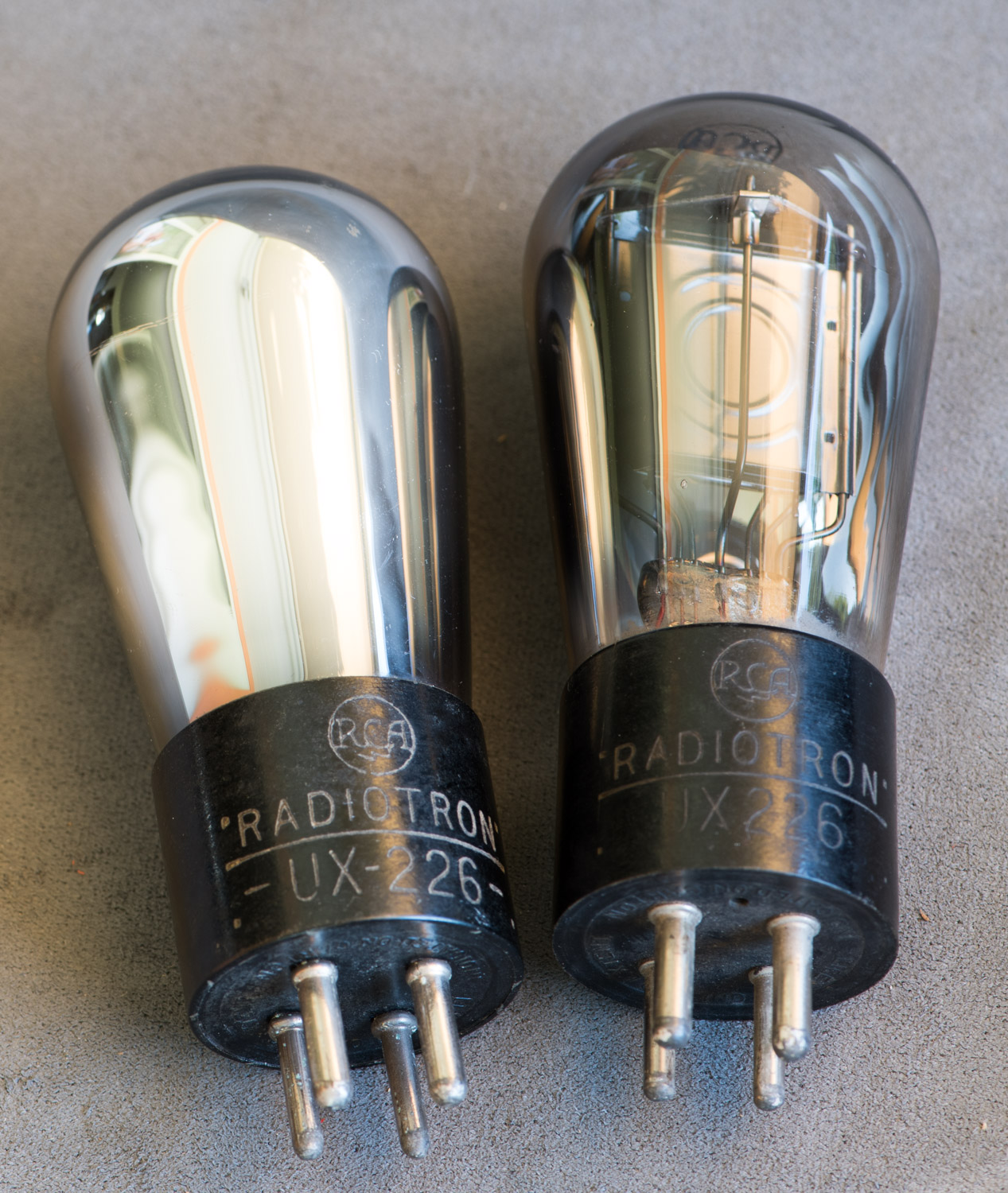
The earliest version had the UX-226 designation:


Cunningham also offered the 26 in various forms. All made by RCA.


Similar packaging as RCA:


Some of their packaging had both the Cunningham and RCA logo:


Cunningham named the early versions CX-326:


For most globe tubes it was typical that one side of the tube was completely covered with getter:


And the plate structure can bee seen from the other side:


Here we get a peek at the grid:


Zooming in:


Cunningham CX326 in it's full glory:


26 made by General Electric:


Tung-Sol:


Westinghouse:


Raytheon:


Thes Ken-Rad came in a bland red box:


Never heard of Calmac, probably rebranded:


Lafayette, made by RCA:


Zenith, probably made by Sylvania:


Philco, probably also made by Sylvania:


Most of these boxes are still sealed:


The Philcos also have versions with shiny plates and coated:


National Union:


Sylvania 26s:


Large boxes, older style:


Tube floated with cardboard insert:


Later style:


This is how it looks when the tube has been removed from the box. This is only possible by tearing the carton:


The globe version made by Arcturus with the distinctive blue glass is highly sought after:


They designated these tubes as 126.


As always, I will also show details of the internal construction of the tube. Don't worry, no precious tube needs to be slaughtered for this. I have a 26 with misaligned plate which is not usable anyways:


The barium getter in these old tubes does not react with air as quickly as the getter of more modern tubes, when the glass is broken. Usually the shiny getter turns white quickly, but in case of the 26 stays shiny:


Here we see that one of the stems on which the plate rests was broken:


Now we have a better view of the grid:


Removing the plate and we can see the grid and also the filament. The filament got broken by removing the plate.


Here we see that the filament is not just a thin wire as in thoriated filament tubes, but has the shape of a ribbon:


Detail photo showing how the grid wires are welded to the rod holding it:


And finally some photos of a 26 in operation:


Like other directly heated tubes with oxide coated filament they glow in a red/orange tone.


Zooming in to the top, showing the glowing filament:


Expect to see more of this tube in upcoming projects. Stay tuned!

Best regards

Thomas