Hi!
In the previous post, I introduced the stereo 300B single ended amp under development. The
6SN7 has been chosen as driver tube. Since the 6SN7 was already covered in a tube of the month post, we will have a look at another type which is electrically equivalent but has a different base, the 7N7.
The 7N7 is a Loktal type. For some back ground information about the Loktal tubes see the 1LE3 Tube of the Month post, the only other Loktal type covered on this blog so far. But more will follow!

The pinout of the 7N7 is shown on the left. As can be seen not only is the base different but also the relative position of the electrode connections. The layout of the pins is symmetrical. This would ease a symmetric stereo layout for example. Connecting both triode systems in parallel is also a bit easier this way. That pretty much sums up the differences to the 6SN7. As mentioned they are electrically equivalent. Amplification factor of 20, plate resistance of about 7kOhms. The heater draws he same 0.6A at 6.3V. However caution needs to be taken regarding the maximum values for plate voltage and plate dissipation since those values changed during the rather long time

the 6SN7 was in production.
Since Loktal tubes never really won wide acceptance in the market they got discontinued rather soon after the introduction of this base. So the 7N7 never went through the same kind of uprating as the 6SN7. It only matches the early 6SN7 versions in this regard. Later versions like the 6SN7GTB have been uprated. A 7N7 could drop right into a circuit designed for the 6SN7 by changing the socket or by using a socket adapter. Unless the circuit is designed to make use of the higher limits of later 6SN7 versions. As always let's have a look at the plate curves as shown in the data sheet and compare them to traced curves from real life tube samples. Here is the set of plate curves as shown in the Tung-Sol data sheet:
And here the curve set as measure on a tube:
These are actually more evenly spaced as the curve set from the data sheet and resemble those of the 6SN7 which is not surprising.
Most of the 7N7 available have been manufactured by Sylvania since they introduced the Loktal base tubes:
A later version:
7N7 made by Tung-Sol:
The Loktal base:
General Electric:
A later GE version:
The next one one is made by Lansdale for the military:
This one has a much longer glass body than other brands. Here compared to a Sylvania:
I never came across that brand before. So I went through my stock and found a General Electric tube in the same style. So probably they had only been rebranded or specially selected by that company for the military.
Rebranding was quite common so you can never be sure if the company which has it's name on the glass really made the tube.
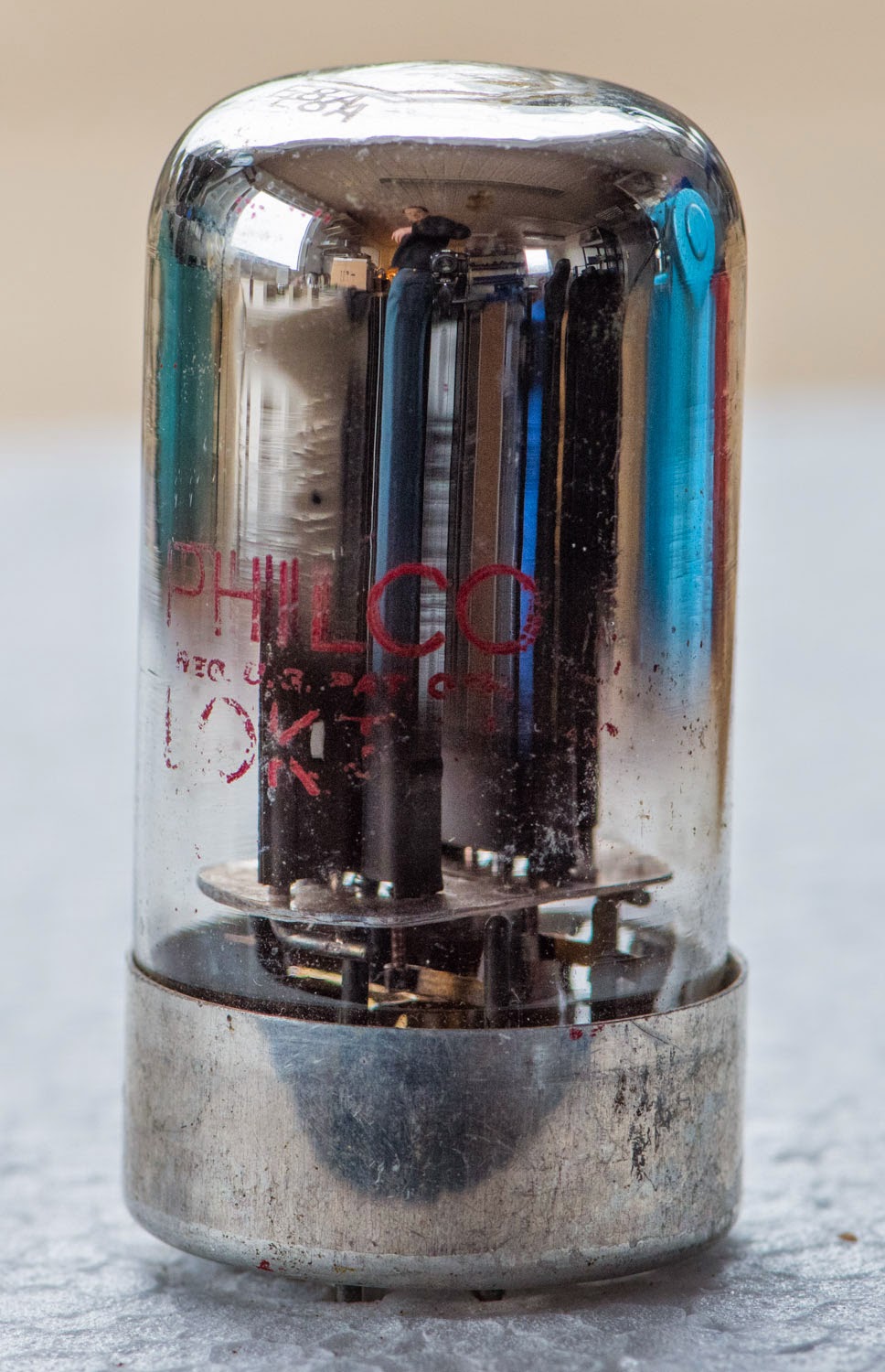
Philco for example did not make their own tubes but got them manufactured by others.
Raytheon:
Although Raytheon manufactured tubes itself, the plate structure of the one above looks like Sylvania.
The same with this
DuMont branded tube:
RCA 7N7:
A close up to the internals of a 7N7:
To get a better view of the internal construction we need to open one. Let's use this Sylvania tube:
The glass removed:
In tis close up the grid wires can be seen:
The heater wires:
A cathode:
The plate:
Grid and cathode:
The internals are the same as those of the 6SN7. They probably came off the same assembly line and just got housed with the different base. Theses quite evident when comparing these two:
Both made by Sylvania, a 6SN7 on the left and 7N7 on the right.
A nice low cost alternative to the increasingly costly 6SN7 if you can work with the different base.
Best regards
Thomas