This is Thomas Mayer's blog about vacuum tube audio, to share updates about new amplifiers and preamplifiers and ELROG vacuum tubes.
DISCLAIMER
All rights of photos and text reserved. Usage of photos or text from my blog on other websites or for any other purpose only with prior permission. If you want to use any material from my blog please contact me by email.
Visit us in F231c (same room as last year) and listen to Bernd's fabulous turntable and tonearm creations through Wolf's SON speakers. Powered by my 211 tower amplifiers, EC8020 LCR phono stage and 10Y line preamp. There will also be some other amplifiers there, like the stereo 300B amp.
Something completely different this month. No amplifier or rectifier tube. While cleaning up some storage space, I came across an old clock which I built many many years ago. It uses tubes for displaying the time, so called Nixie tubes. The Burroughs B6091.
Nixie tubes are cold cathode tubes for displaying information. Mostly known are those which show numerals from 0 to 9 but there are also others showing letters or electronic symbols.
Cold cathode means they do not have a heater. They operate by a glow discharge. There is one common anode in the tube to which a positive voltage is applied (typically in the order of 150V). There is a separate cathode for each of the numerals. Each of them is connected to it's own pin. Whenever a cathode pin is connected to a voltage more negative than the plate (typically close to ground) the respective cathode exhibits an orange glow which looks like this:
The term Nixie was coined by Burroughs. It was an abbreviation for Numerical Indicator Experimental No. 1. The name stuck to it and was generally used for indicator tubes.
Nixie tubes were made by various manufacturers in different sizes, shapes and arrangements of the display. I specifically like the Burroughs B-6091 for it's round shape and the numerals visible from the top of the tube.
The base almost looks like a 12-pin Compactron.
But it has 13 pins. 1 pin each for the 10 numerals, 1 for the cathode and 2 unused pins.
When taking this photo from the side, I discovered an unusual feature, a little glass stem with a wire wound around in a spiral.
Here is another shot:
The ends of this wire are connected to the two pins marked as internal connection in the pinout (see above).
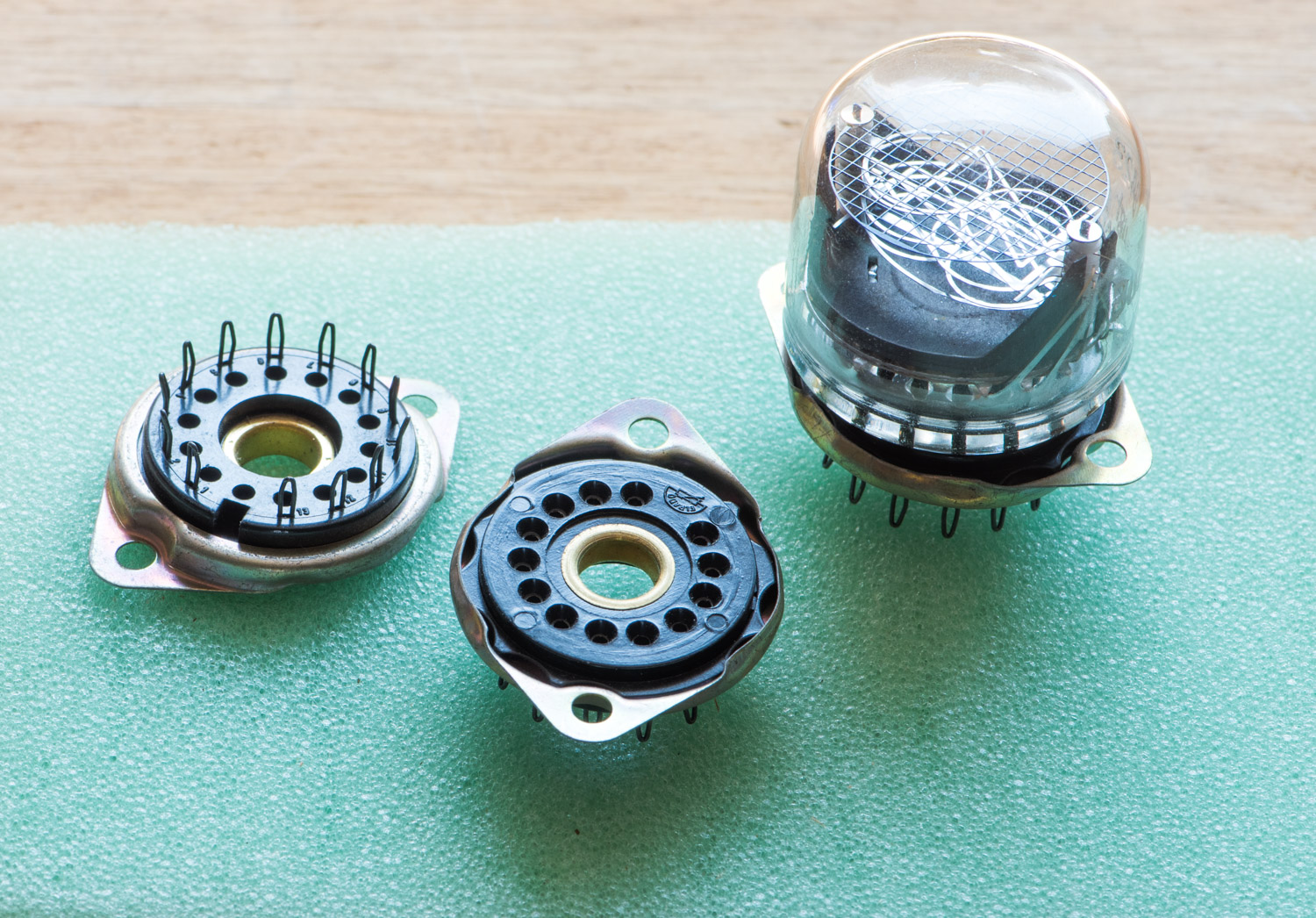
So this is giving a low impedance connection between those pins. The data sheet does not say anything about this. The purpose is probably to provide a possibility for the circuit to detect if a tube is plugged into it's socket or not. Speaking of sockets, these are harder to find than the actual tube.
The tubes come in nice blue/white boxes:
The boxes give excellent internal support for the tube:
The photo above shows nicely how the numerals are arranged in layers. At the side they are supported by ceramic rods.
These provide insulation between the cathodes.
The order in which the numerals are arranged is well thought out for best visibility.
Close up:
Most people who are into tubes come across Nixies at some point and a nice application for them is a digital clock:
I built this almost 20 years ago and I found it in a closet where it sat unused for more than 10 years. Still works fine.
Here a video with the clock in action:
A close up of the seconds counter:
They would also make nice volume or source indicators on preamps.
Close up which shows the layering of the numerals:
Here the glow around the metal is nicely visible:
When the seconds count away and the numerals jump around, this gives a sense of depth.
Here from a more extreme side angle:
The logic board of the clock, built with '74' series TTL ICs:
There were also TTL decoder chips available specifically for Nixie tubes. Each of the cathodes got connected to a pin and the IC decoded a 4-bit binary number such that the correct cathode got shorted to ground. If the decoding is not done properly also several numbers can be illuminated at the same time. Here simulated with a longer exposure time on the camera:
These Nixie tubes have a very cool retro look to them.
I hope you enjoyed this installment of the tube of the month series about the Burroughs B-6091 Nixie indicator tube.