
This month I would like to show a tube which most of you probably never heard of : The 957.

The 957 is an acorn tube. This series of tubes is named like that due to their shape which resembles that of an acorn.
 Acorn tubes are baseless. The connection pins come out of the glass on the side of the bulb. This and their small size minimised parasitic capacitances. The intention was to develop a series of tubes specifically suited for high frequency applications. The 957 is a directly heated small signal tube, the sister of the 958A which I already presented in 2014. The 957 has the same very low filament voltage of 1.25V as the 958A but needs even less current. The filament only consumes 50mA which made this tube especially suitable for portable, battery operated applications. Both tubes have very similar amplification factors. The 958A has a mu of 12 and the 957 has a mu of 13.5. But the low filament current of the latter comes at a cost which means about half the transconductance and twice the plate resistance compared to the 958A. For the complete technical specs refer to the RCA data sheet. The 957 would be usable in resistance coupled audio amplifier stages. Needless to say that DC operation of the filament would be mandatory for hum free operation. It anyways was only specified for DC filament voltage.
As can be expected from a directly heated triode, linearity is very good. Note that the data sheet shows plate curves also for positive grid volts. Here a set of plate curves taken from a tube with the tracer:

A 957 made by RCA fro the military:

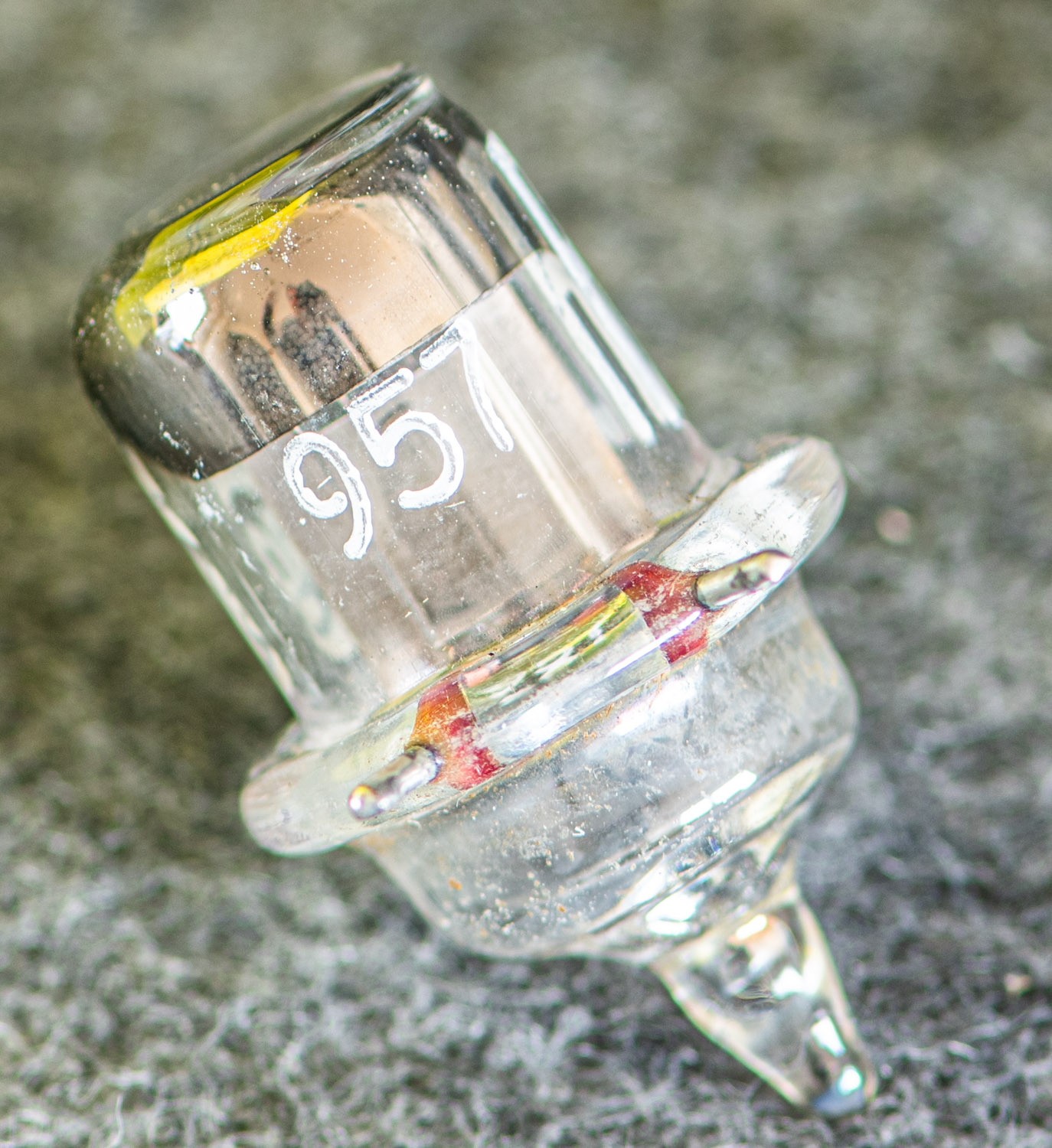


Another military 957 made by a company called Sonotone Corp.


Let's see more of the construction by dissecting this tube:
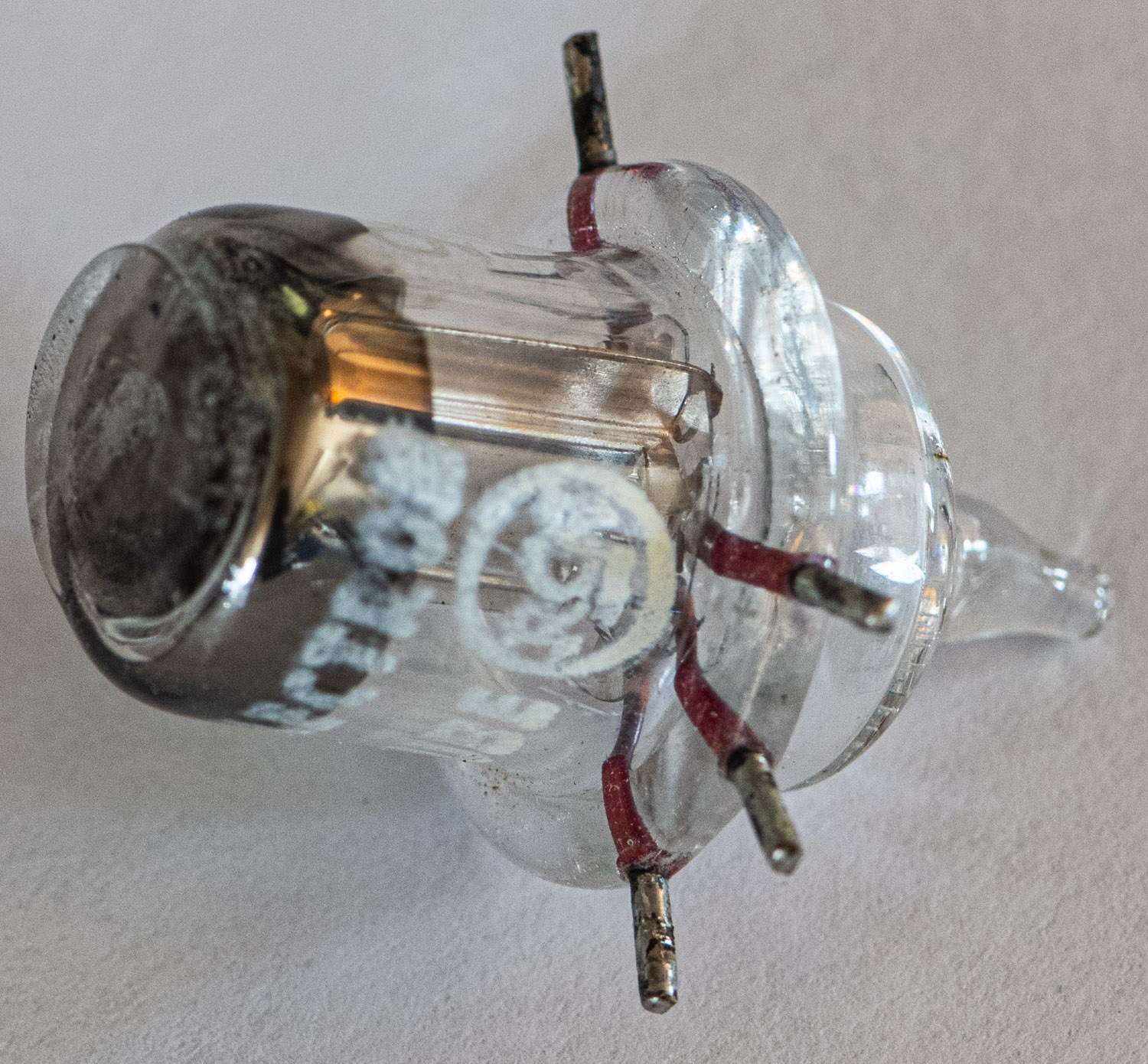
The electrode system is tiny:
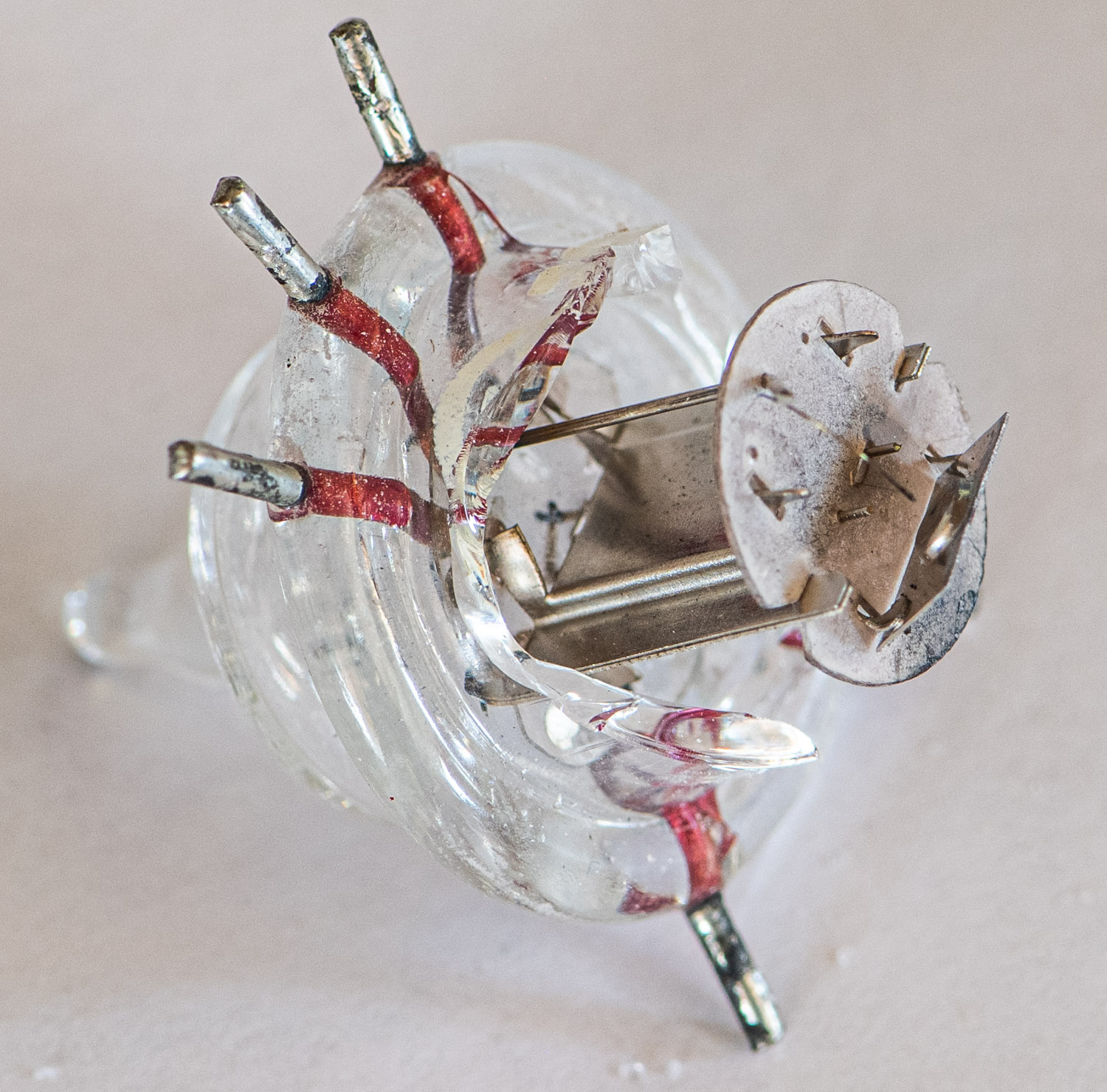

The filament consists of a single wire held on the top by the rod at the left side:


The delicate structure is easily damaged. Unfortunately I completely deformed the grid.

Here the rod which held the filament with the filament string still attached.

As expected this tiny filament shows only a very dull glow in operation, which can only be seen from the bottom.

Microelectronics from the 1940ies!
Best regards
Thomas


