DISCLAIMER

All rights of photos and text reserved. Usage of photos or text from my blog on other websites or for any other purpose only with prior permission. If you want to use any material from my blog please contact me by email.

Wednesday, August 7, 2019

Deutsche Elektronenröhren Manufaktur GmbH Anniversary

Hi!

Today it is exactly three years since I announced the founding of Deutsche Elektronenröhren Manufaktur GmbH and the continuation of the manufacturing of ELROG tubes after the former ELROG GmbH Elektronenröhren & Co KG went bankrupt.


A lot has happened in those 3 years. Not only did we completely redesign every tube type to increase reliability and sound quality, we also developed new tube types.


The ER845 and ER211 were the first 2 types made by the former ELROG GmbH, which was joined by the ER300B in 2014. The most notable changes were done to those two, by inverting the structure to raise the heat generating plate higher up in the bulb as done in other 845 and 211 tubes. This eliminated heat problems in amplifiers with poor air ventilation around the tubes.


The ER300B was joined by two other UX4 based directly heated triodes, the ER50 and ER801A, the latter not only meant as replacement for the original types 801, 801A and VT62 but also the 10Y and VT25. The ER300B got completely overhauled with a more ruggedised filament and new plate structure. The thoriated tungsten filament was kept as this is the main reason for the sound qualities of our ER300B which is highly regarded as among the very best on the market and preferred by many over any oxide filament type.


And of course we also decided to make rectifiers in form of the ER274B and ER274A. These rectifiers surpass other 274B and 274A types with higher voltage rating. Many of our customers replace a 5U4 with the ER274B and it can also work in applications designed for the 5R4.


The ER284 and ER242 are premium variants of the 845 and 211 and are electrically compatible with those. They use molybdenum plates instead of graphite.


The latest addition are the ER887 and ER888. These are new tube types which do not have old production equivalents. These are driver tubes specifically designed to provide the large grid voltage swing to drive 845 output tubes in the best possible manner and in a 2 stage amplifier. Both types are electrically identical. The ER888 uses a molybdenum plate while the ER887 has a graphite plate. With these we now have a total of 11 tube types in the portfolio. Development will not end here and more new types will follow.


I would like to thank our customers and the entire tubephile community for the continuous support and encouragement. And of course a big thank you to the hard working staff at Deutsche Elektronenröhren Manufaktur GmbH, producer of ELROG vacuum tubes made in Germany.


Best regards

Thomas


Wednesday, July 31, 2019

Tube of the Month : The 6BL7

Hi!

This month we take a look at a double triode. Meet the 6BL7.


The 6BL7 was developed for TV vertical deflection oscillator and amplifier applications. It is similar in structure and pinout to the 6SN7 and 6BX7 but they have different amplification factors and other parameters.


The octal base pinout is shown on the left. The 6BL7 has an amplification factor of 15 which classifies it as medium mu triode. It has a hefty 60mA maximum cathode current and each of the two triode systems can dissipate 10W. Albeit not both at the same time. Total maximum dissipation for both triodes together is limited to 12W due to the compact size and small bottle. Still impressive and both systems connected in parallel would be able to work in an output stage of a small power amp or headphone amp. Capable to deliver about 2W in single ended operation. The plate resistance is about 2k per system so 1k when operated in parallel which is in the territory of typical output tubes. Such parameters require a rather high filament current of 1.5A. It would also make a great driver for large output tubes since it can deliver quite impressive voltage swings. For complete technical specs refer to the General Electric data sheet. Lets have a look at the plate curves:


And some curves taken from a tube on the tracer:


An interesting tube which gets little attention nowadays.


I haven't really used this tube myself and the small heap of 6BL7GTA above is all I got.


So lets have a closer look. Here is the tube in all its glory:


The rather large plate structures (for such a small tube) are immediately apparent.


Being designed for TV deflection service the tube had to be quite rugged.


The tube in operation:


A nice little gem!

Best regards

Thomas


Friday, July 12, 2019

The Digital to Analog Converter

Hi!

Here some photos of the first customer ordered DAC to be shipped soon.


Besides the black color for the transformer covers and capacitors this unit has an upgrade to the high voltage power supply compared to the prototype.


The PSU uses an ELROG ER274A rectifier in a hybrid bridge together with 2 TV dampers.


For some thoriated tungsten glow from both the main unit and the HV PSU.


The digital power supply is again housed separately.


A peek into the digital power supply shows why, separate choke filtered supplies for the receiver and DAC boards.


The DAC unit:


The DAC will be shipped with ELROG ER801A output tubes. Old production 801A or 10Y can be used as well.


And also an inside view showing the DAC and receiver boards.


Some more infos about this DAC here.


Drop me an email if you are interested in such a DAC for yourself

Best regards

Thomas

Friday, June 28, 2019

Silver Goodies

Hi!

Just received a shipment of silver transformers and chokes for upcoming projects.


Silver Output and interstage transformers as well as plate chokes for the differential 46 mono amps, line output transformers for various preamps, phono stages and a silver version of the DAC.


And plenty line input and MC step up transformers.


Best regards

Thomas

Thursday, June 20, 2019

Tube of the Month : The 6P5

Hi!

This months tube is an indirectly heated triode, the 6P5.


In 2015 I did a small series of early small signal tubes covering the 27, 37, 56 and 76. The 6P5 is the successor of the 76.

Electrically it is equivalent to the 76 but it has an Octal base instead of UX5. The Octal pinout is shown on the left. Otherwise it is interchangeable. For all technical parameters refer to the Tung-Sol data sheet. The 6P5 could be regarded as the transition type between the early indirectly heated triodes and the later, more modern medium mu types like 6J5 or the ubiquitous 6SN7. The 6P5 has the same pinout as the 6J5 but is not necessarily interchangeable. It might replace the 6J5 in certain applications and would provide less gain of the circuit can cope with the higher plate resistance. The 6P5 was made in ST 'shoulder type' glass, then named 6P5G or in straight sided glass, named 6P5GT. As usual let's have a look at the plate curves:


As expected as linear as you could hope for from an indirectly heated tube. Lets see a real tube on the tracer:


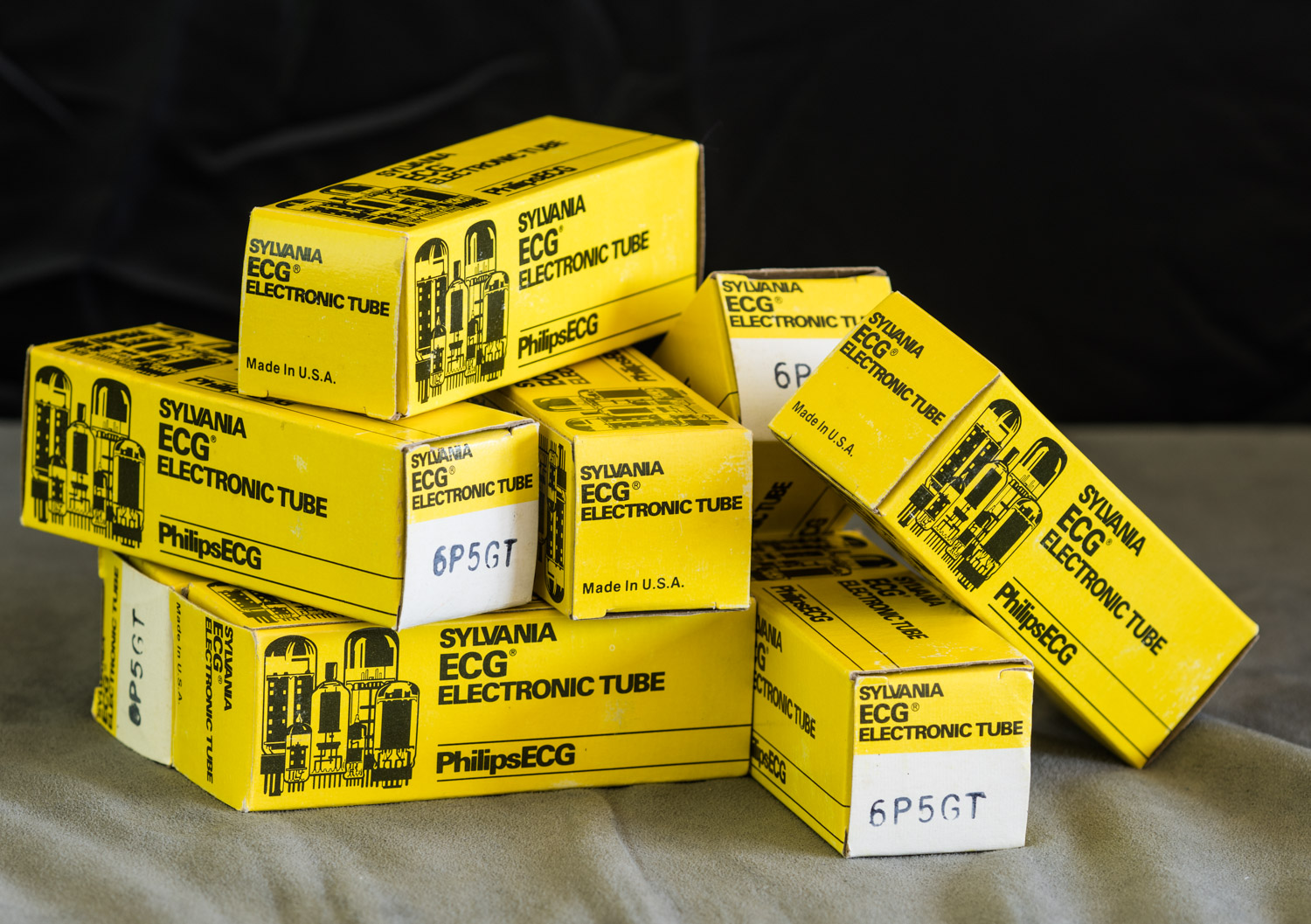
Admittedly I never used any 6P5 tubes myself and only have a small stock. This measly pile is all I got:


All made by Sylvania/ECG when they were part of Philips so rather late manufacture. Unfortunately I have no 6P5G shoulder types to show. Only these Sylvania 6P5GT.


Let's look at it from all sides:


Some close ups:


Details of the box:


I wish I could show more different varieties of this interesting tube.


The Octal base:


Now let's open this one to see the inner construction:


Glass removed:


Grid and cathode:


Close Ups:


The heater wire:


Cathode:


Grid:


Quite intricate engineering! When lit up not much of a light show as is usual with indirectly heated tubes:


Just a little glow from the heater at the bottom and top of the tube:


Another widely unknown but interesting tube. I hope you enjoyed the presentation.

Best regards

Thomas