This is Thomas Mayer's blog about vacuum tube audio, to share updates about new amplifiers and preamplifiers and ELROG vacuum tubes.
DISCLAIMER
All rights of photos and text reserved. Usage of photos or text from my blog on other websites or for any other purpose only with prior permission. If you want to use any material from my blog please contact me by email.
This month I would like to present a tube which is long overdue to get a spot in the Tube of the Month series. Meet the mighty 845.
The 845 is a directly heated transmitting triode designed for use as audio frequency modulator or amplifier service.
It uses a thoriated tungsten filament which operates at 10V and needs 3.25A of current. Like all thoriated tungsten filaments it lights up in a bright almost white color when in use. The 845 shares the same filament, bulb size and base with the 211. Both use a 4 pin Jumbo bayonet style base. But that is where the similarity ends. The 845 has an amplification factor of 5.3 which comes with 1700 Ohms plate resistance while the mu of the 211 is 12 at 3900 Ohms rp. In Class A1 single ended use about 25W can be obtained from a 845. But to get this the tube needs 1250V at the plate and a driver which is capable to provide a voltage swing of almost 400V peak to peak. These requirements make it quite a challenge to use the 845 as output tube. The output transformers not only need to be able to handle the power delivery but need to be isolated to withstand the high supply voltage. This voltage insulation requirement doubles since the plate of the 845 will swing to almost twice the B+ voltage when driven to full power. That is why suitable output transformers are bulky, heavy and expensive. When you look at the data sheet you will find one of the reasons (besides it's power capability) why this tube is quite popular. It has amazingly linear plate curves:
And this quality holds up in real life, here the plate curves of an actual tube:
I remember the first time when I read about the 845 in the summer 1992 issue of Sound Practices. Back then this magazine occasionally had an article named 'Meet the tube' which was the role model for my Tube of the Month series.
Little had I known back then that more than 20 years later I would be a manufacturer of 845 tubes myself.
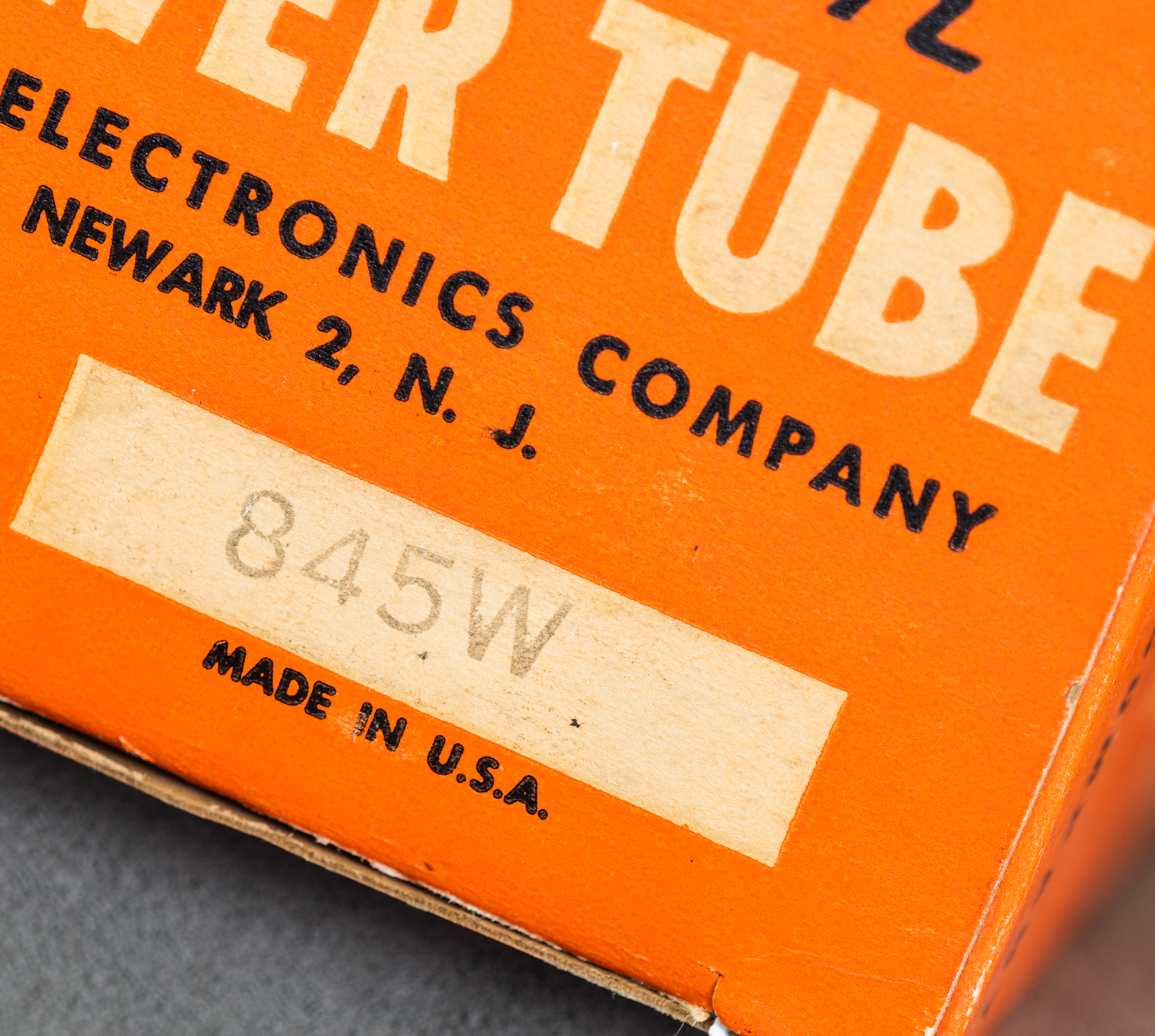
When I started to use these big transmitting tubes I was more drawn to the 211 and therefore never bought many old production 845 tubes and since I have a tube factory at hand I stopped buying old tubes altogether. So all I can show besides the ELROG variants of this tube are some United Electron 845W.
They are packed in beautiful oversized cartons.
The United Electron 845 in all it's glory.
The UE 845 has some distinct features not seen in other tubes.
A little glass stem protrudes from the tube into the tube which is used to mechanically hold the internal structure at the top.
Unlike most tubes which have the getter flashed to part of the glass bulb. In these it is contained in a small cylinder.
No getter mirror anywhere on the glass.
Here we see the connection from the plate to the base pin, not your typical audiophile wire.
Also note the use of ceramic instead of mica discs.
The base:
Next I'd like to show the ELROG 845 made by Deutsche Elektronenröhren Manufaktur GmbH.
They always come as matched pairs.
The specs match those of the old production 845 tubes.
Each tube has a serial number:
Aluminum / Teflon base:
Next a few photos from the tube factory to show some of the production steps.
Sealing the glass:
Two video clips showing the sealing process:
The freshly sealed tube on the vacuum pump:
The plate gets heated through RF induction for outgassing:
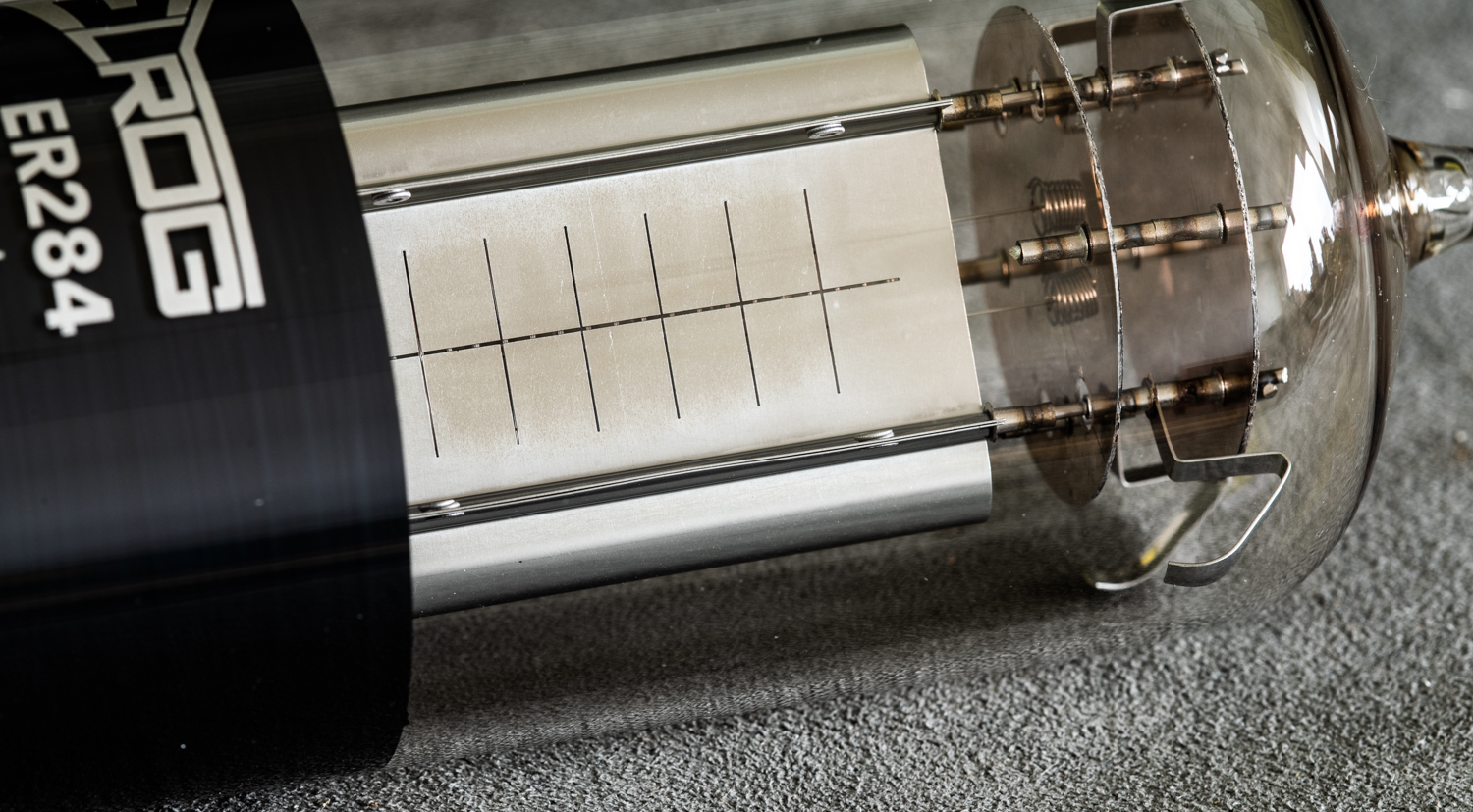
Like old production 845s made by RCA, General Electric, Westinghouse and the United Electric the ELROG ER845 has a graphite plate. Western Electric manufactured a tube with the same specs as a 845 but used molybdenum as the plate material. They called it 284.
In appreciation of the Western Electric 284 we named our molybdenum plate version ER284.
It has the same specs as the ER845 and is fully interchangeable with any 845.
And now some photos of the tubes in operation. Starting with the ER845 in one of my amplifiers:
Here the tube is paired with an ER887 which we specifically developed as driver tube for the ER845.
Some close ups:
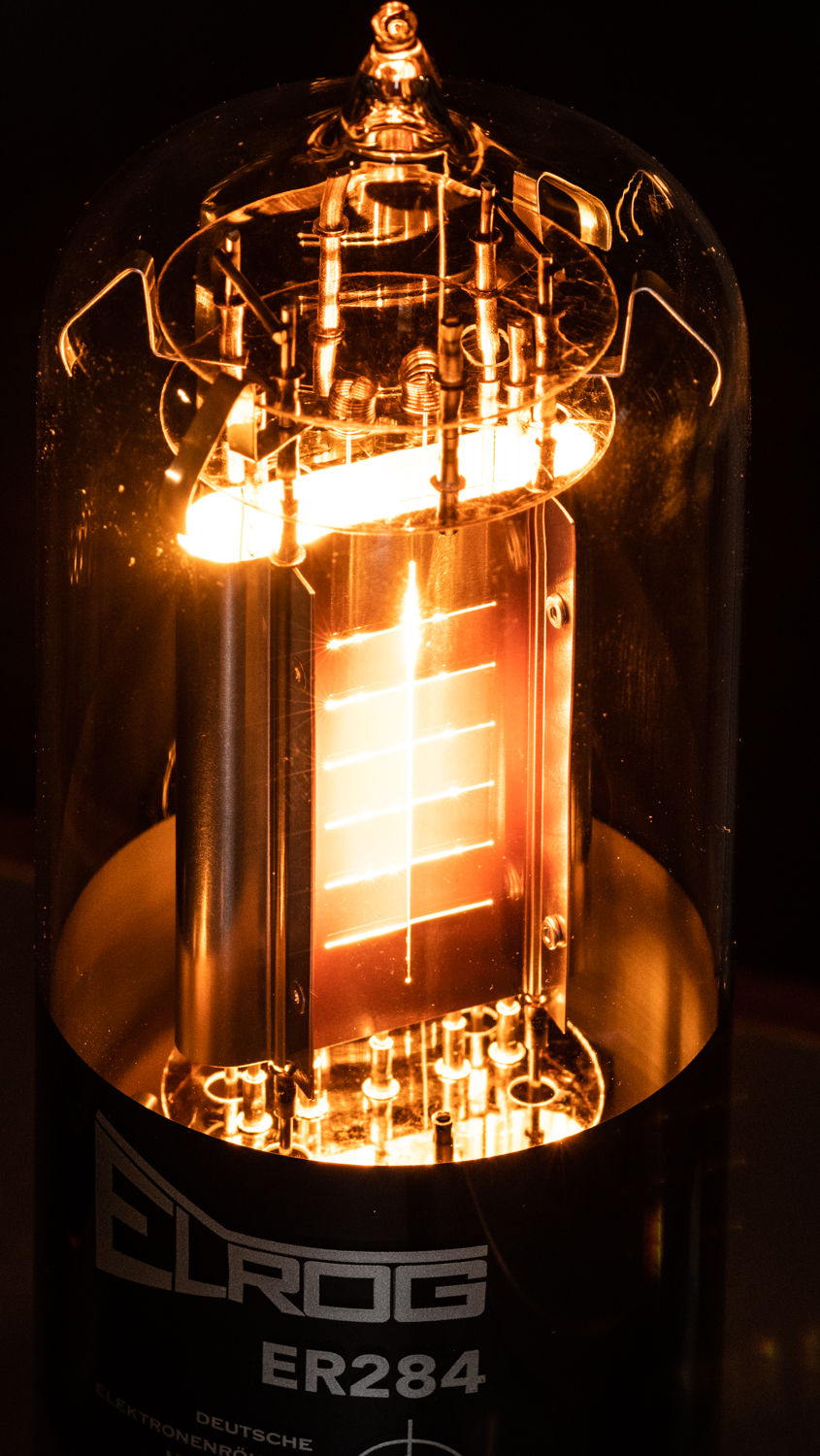
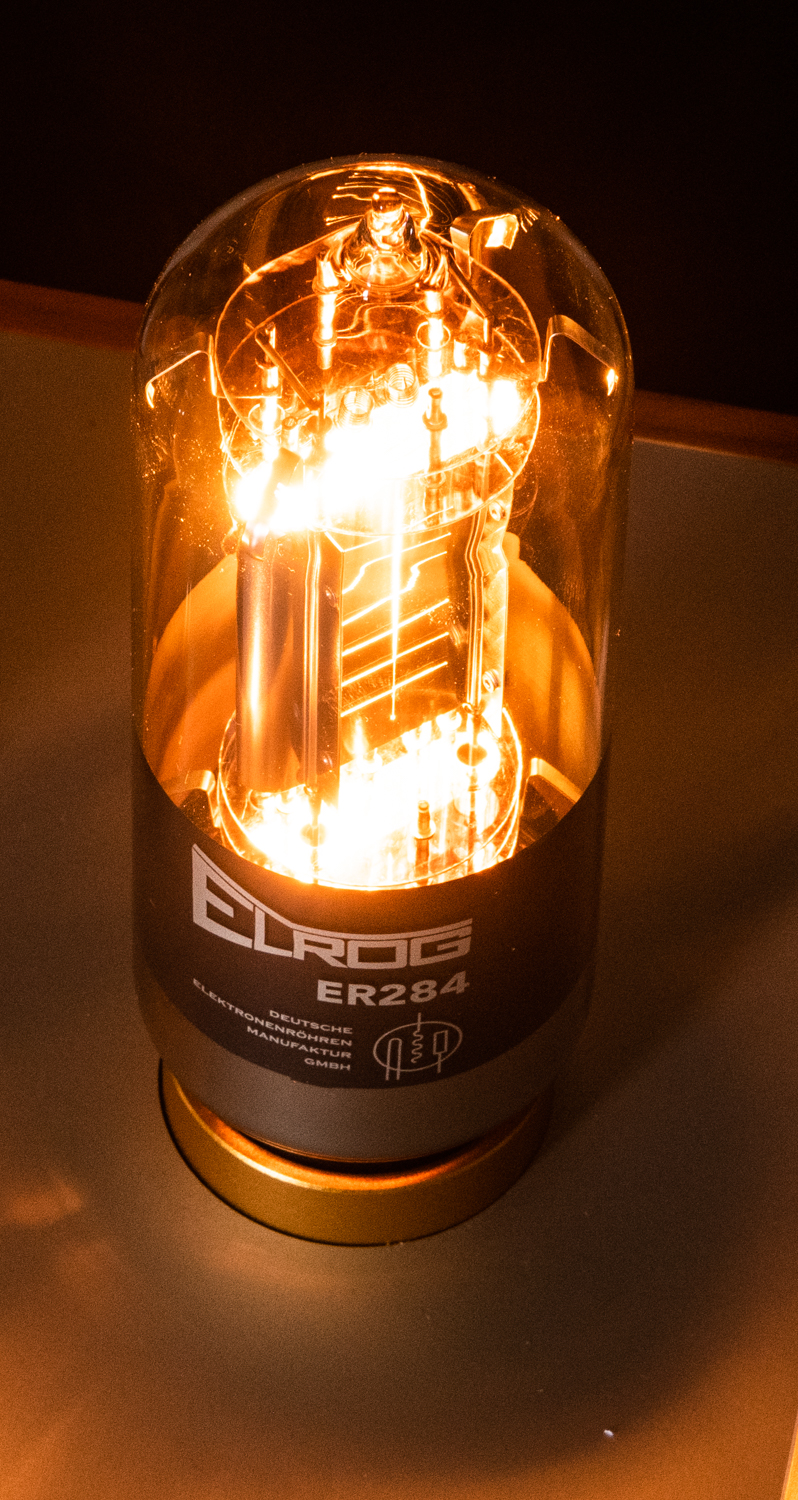
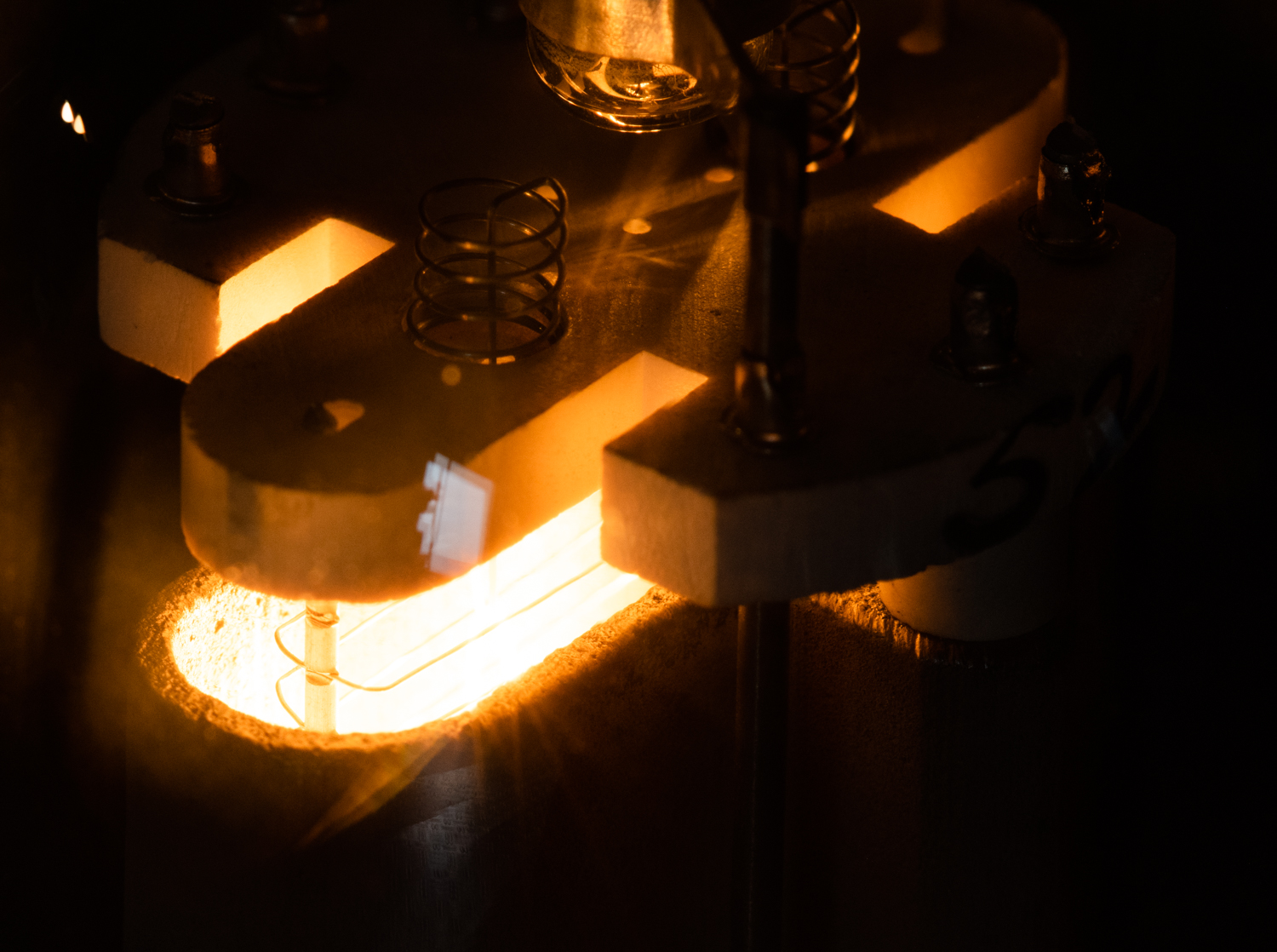
The ER284 gives more of a light show due to the slotted molybdenum plate which lets more light from the filament get out:
And this is then topped after the plate voltage is applied and the tube is at operating temperature.
In normal operation the plates show an orange glow.
And lastly some shots of the United Electric 845 in operation.
That is all I have to show about 845 tubes. If you have some nice photos of 845s from other manufacturers and want to see them here, please email them to me and I will add them to this post.
Last month I already posted some feedback from users of the new TM801A tubes. In the meantime I received more feedback which I am allowed to share with you.
The first report is from a gentlemen who uses a silver 10Y linestage along with 46 drive 46 mono blocks and a D3a phono stage. He compared both ER801A-Mo and TM801A against old production Sylvania 10Y in the 10Y line preamp. Here is his report translated by me from german:
Hello Thomas!
I just finished the comparison of the tubes which you sent. Here is my report:
The first tests were done with LPs played on my AMG Viella "Forte" turntable with AMG JT12 "Turbo" tonearm and the Myajima "Kansui" cartridge which was hooked up to the D3a phono. These are the three LPs I concentrated on:
I spent the first two hours to listen with the ER801A-Mo. I did not expect such big improvements compared to my Sylvania 10Y.
Improvements are immediately audible in all areas with regard to transparency, details and soundstage. On the Oscar Peterson record details appeared which I did not notice before. On the Scheherazade the placement of the different instrumentalists got more precise with more air between them. On the chamber music record it is the tone colours of the instruments which is very charming with the silky violins.
After a 1 hour break to let the tubes cool down I changed to the TM801A. What can I say about these tubes? Well, everything the ER801A-Mo already does very well, the TM801A does even better.
The next day I continued experimenting with other music and digital recordings from Qobuz. Here the results are the same as from the day before. Finally I did blind listening (my wife determined the order of the tubes in use). And again it was the TM801A which won to my ears. Both tubes simply reproduce music beautifully.
So I decided the TM801A remains in my 10Y linestage!
Ich habe gerade die Vergleichstests der Röhren beendet, die Sie mir geschickt haben. Hier ist der Bericht :
Die ersten Tests wurden mit LP's durchgeführt, die von meinem AMG Viella „Forte“-Plattenspieler gelesen wurden, der mit dem AMG JT12 „Turbo“-Arm und dem Myajima „Kansui“-Tonabnehmer ausgestattet war, der mit dem D3 verbunden war. Die drei LPs, auf die ich mich konzentriert habe, sind: Oscar Peterson, Scherazade und Koppoo Trio.
Die ersten zwei Stunden verbrachte ich damit, dem 801A mo zuzuhören. Ich habe keine so große Verbesserung gegenüber meinem VT25 (Sylvania) erwartet.
In allen Bereichen sind die Fortschritte sofort wahrnehmbar, sowohl in Bezug auf Transparenz, Details und Verräumlichung. Auf der LP von Oscar Peterson tauchten Details auf, auf die ich bisher nicht geachtet hatte. Auf Scheherazade ist die Platzierung der verschiedenen Instrumentalisten präziser geworden und es gibt mehr Luft zwischen ihnen.Auf der Kammermusik-LP ist es die Klangfarbe der Instrumente, die mit seidigen Streichern besonders reizvoll ist.
Nach einer einstündigen Pause zum Abkühlen der Röhren wechselte ich zum TM801A. Was soll man zu dieser Röhre sagen? Nun, was der 801A mo schon sehr gut macht, macht der TM801A noch ein bisschen besser!
Am nächsten Tag experimentierte ich weiter mit anderer Musik sowie mit digitalen Aufnahmen von Qobuz und meiner eigenen Diskothek. Auch hier stimmen die Ergebnisse mit den Tests vom Vortag überein. Schließlich ging ich zum blinden Hören über (es war meine Frau, die die Reihenfolge der Röhren wählte). Und wieder ist es der TM801A, der meine Ohren gewonnen hat. Beide machen einfach schöne Musik mehr kann ich nicht sagen !
Next a report from a gentlemen whom I recently delivered his all silver differential D3a phono stage.
The first sound impressions of this system with power amps and line stages were already posted in February. When I delivered the phono I also left two pairs TM801A to try in the linestage. BTW this is one of the very best systems I ever had the pleasure to listen to and the best analog reproduction I experienced. The analog front end of this system is superbly fine tuned and adjusted with a lot of passion and experience. After I listend to the TopWing Red Sparrow cartridge .for the first time in this system it was clear that I had to get one for myself.
Here the report:
When my Differential D3A Phono Silver was delivered by Thomas in early August and sound for the first time in combination with the Differential ER 801A Line Silver and the TM300B SE Monos Silver and the vinyl front end (Doehmann Helix One Mk2, Acoustical Systems Axiom tonearm and Top Wing Red Sparrow pickup) on the Aries Cerat Symphonias it was immediately clear, this chain fulfills all my hopes for a very subtle, realistic music reproduction that offers a wealth of the finest timbres and spatial information, playful, effortless dynamics and wonderful timing. The musicality and the realism of the presentation was so convincing that I didn't believe the new TM801A, of which Thomas brought 2 pairs, would really intensify the sound experience in my chain. Oh how one can deceive oneself. When I finally got around to testing the new TM801A in the Differential ER801A Line Silver after a few weeks, it was clear after a few minutes that I was so wrong. The synergy of the TM801A in the preamp and the TM300B in the monos is fantastic. The previously described sound qualities are clearly intensified again, without any showmanship or exaggeration. Listening to music becomes an even more moving experience. Fantastic! The journey of sound discovery through my small collection of LPs begins anew.
Thank you Thomas for letting all that happen.
Just a final remark. There are many audiophiles who think that the extensive use of silver in such a system would automatically result in a too bright and harsh sound. Maybe this is true for certain pre-amps/amps but definitely not for the ones Thomas builds.
Thanks a lot to these two gentlemen to sum up their listening impressions. I am always reluctant to write about sound myself since I am of course heavily biased and prefer to post independent views.
I often get inquiries about headphone amplifiers. Although I do have a headphone amp in my portfolio with the E55L as output tubes. Many want a DHT.
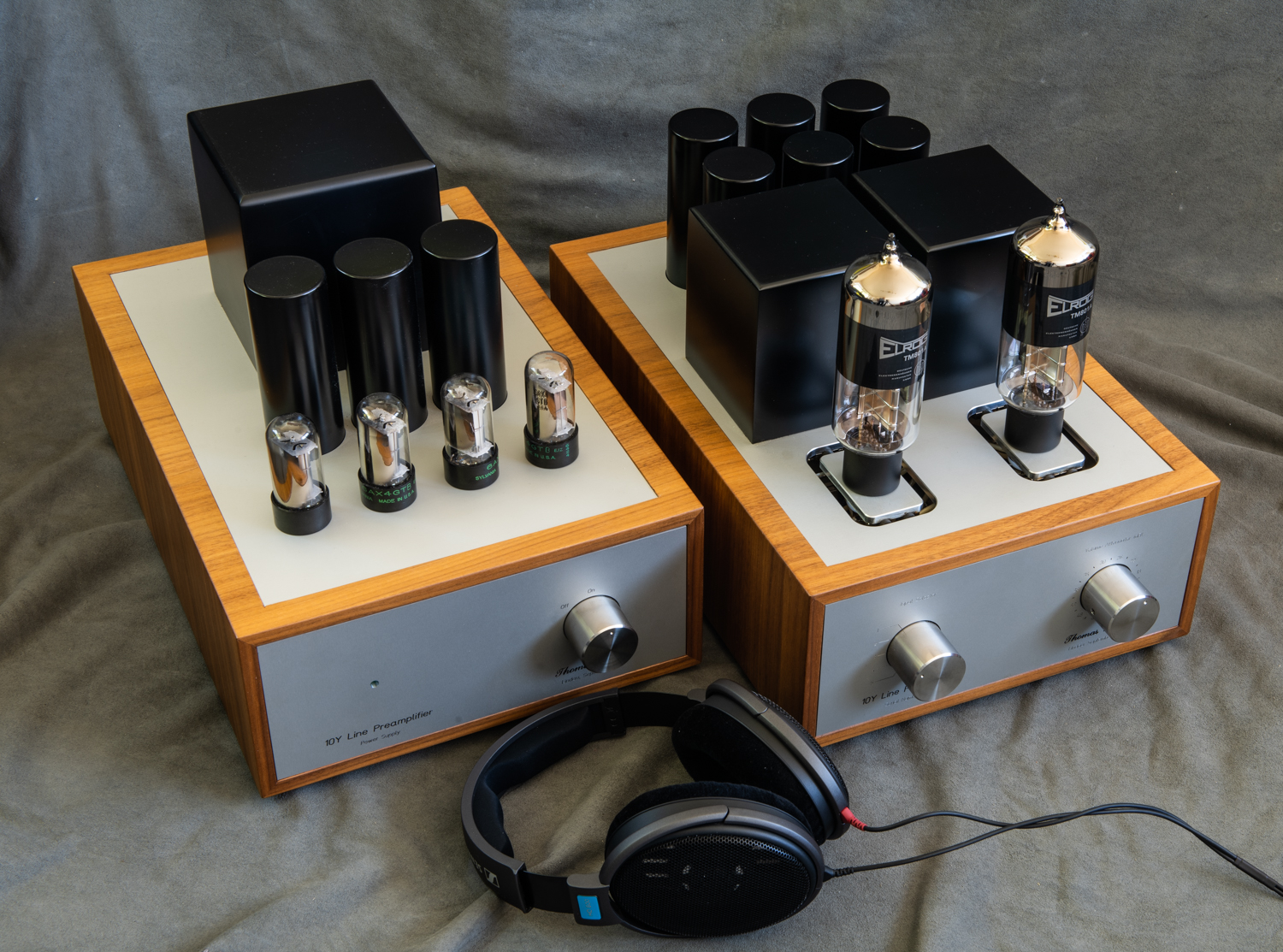
The 10Y line preamp can perfectly drive high impedance headphones (300 Ohm or more) and is useable as a normal preamp at the same time. It works very well for example with the Sennheiser HD600 shown in the photo. This HP has an impedance of 300 Ohms. Existing 10Y line preamps can be used with headphones simply with a suitable adaptor. For new builds, headphone jacks can be added at the front and/or back of the unit.
For those who have lower impedance headphones, I am proposing to add a 'booster stage' which is then driven by the 10Y preamp. This booster stage can be built with any suitable DHT. For example 45, 46, 2A3 and of course 300B or even another 10Y or 801A. The booster stage would get it's own separate power supply.
Such a system could be used to drive any headphone on the market and even very high efficient speakers.
If you are interested in your own state of the art all DHT headphone system, drop me an email