DISCLAIMER

All rights of photos and text reserved. Usage of photos or text from my blog on other websites or for any other purpose only with prior permission. If you want to use any material from my blog please contact me by email.

Tuesday, December 31, 2019

Happy New Year!

Hi!

As the year comes to its end, it is time for the traditional Happy new Year post.


It is hard to believe that we are already at the end of the decade and will enter the 2020s tomorrow.


2019 was quite a busy year for me with lot's of new things. I finally got to introduce my own line of Digital to Analog Converters.  The first version had its public debut at the High End in Munich and is now accompanied by 2 more variants.


The line up of phono stages also saw a new variant with the development of the SplitPath RIAA, a concept which I had on the back burner for years but finally got around to implement.


And it led to a new full function preamp with line and phono in one chassis (plus external power supply), the D3a preamplifier.


A new tube joined the family of power tubes which I use, the 6KN6, which were featured for the first time in a set of mono amplifiers.


Of course the 46, my favourite of the old production tubes, continued to play a big role.


A set of all silver fully differential monos marks the top end of the line up of 46 amplifiers.


And of course ELROG tube manufacturing played the most important role with Deutsche Elektronenröhren Manufaktur already celebrating its 3rd anniversary this year.


2019 saw the introduction of the 11th ELROG tube type, the ER888.


The tube is used as driver tube in single ended ER284 amplifiers.


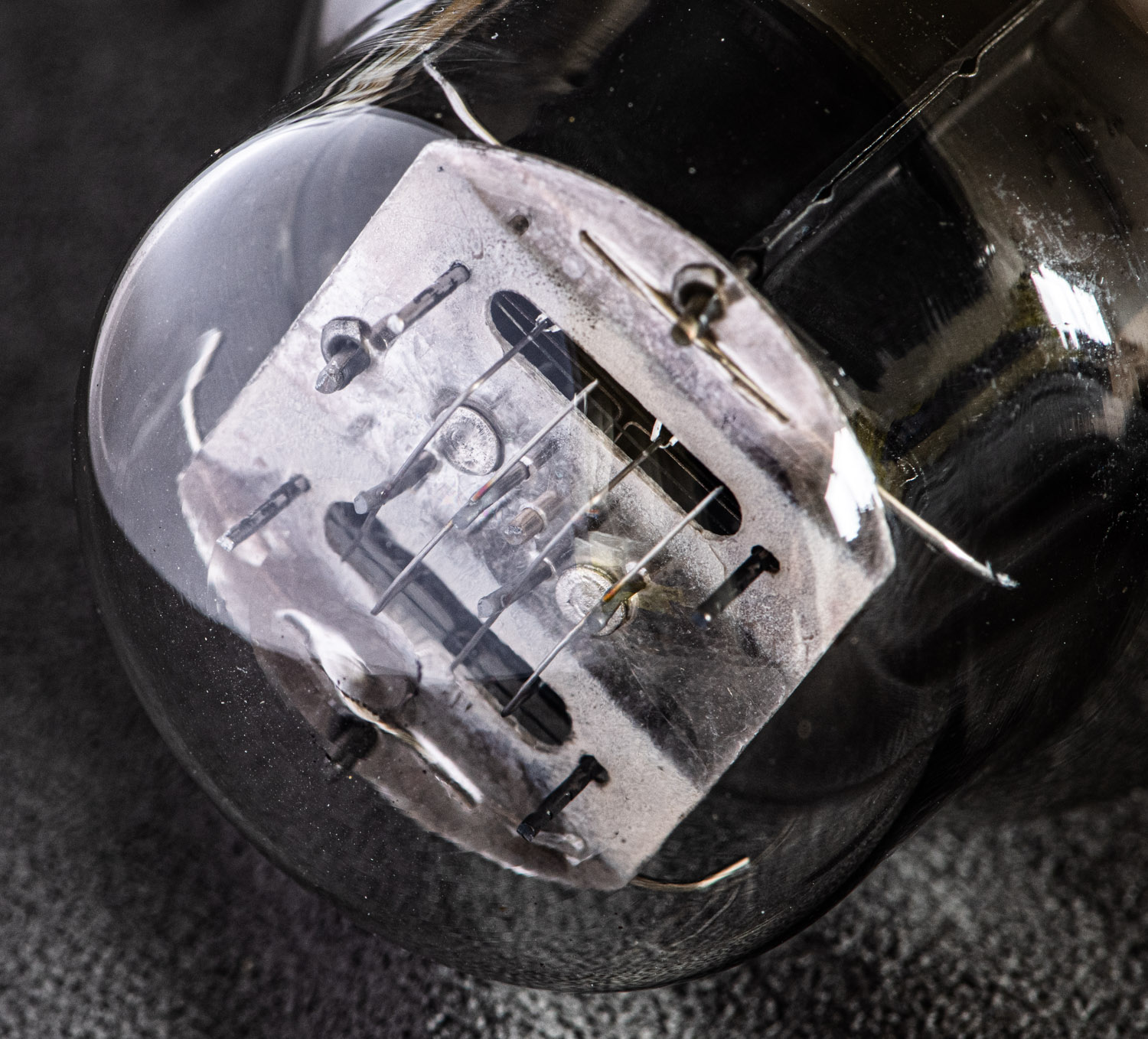
It features a slotted molybdenum plate.


Which allows the filament to give off more of its light.


So what are the plans for the next decade?


Of course I will continue to serve music lovers with hand built equipment.


I am very happy with the portfolio of electronics as it stands now.


Especially with the latest additions of this year I feel it is quite complete.


Of course new ideas can always pop up, but I plan to reduce the rate at which I built amps a bit and concentrate more on the tube production.


Blog activity was already a bit reduced this year, as there were too many activities going on which prevented me from writing more posts.


The tube of the month series has more than 100 entries now. But it is foreseeable that I will run out of tubes to show. So this series of posts might have to come to an end some time. Unless you want to see certain tube types to be featured and you can provide some samples for photos. I would happily accept suggestions. Loaned tubes will of course be returned after the photos are taken. Drop me an email if you have some interesting tubes which would be worthwhile to show.


At Deutsche Elektronenröhren Manufaktur GmbH we will continue to develop new tubes types.


I plan to present some new developments at next years High End show in Munich.


I'd like to thank all friends, customers, partners, readers of my blog and the staff at Deutsche Elektronenröhren Manufaktur GmbH for a great 2019.

Happy New Year
Frohes neues Jahr
Bonne année
新年快乐

Thomas

Sunday, December 22, 2019

Tube of the Month : The 6A5

Hi!

In this last tube of the month post of the decade I would like to present a rather unusual and seldom heard of tube. The 6A5.


The 6A5 is an indirectly heated power triode with the same electric parameters as a 2A3, except for the 6.3V indirectly heated cathode.

The 6A5 has an 8 pin Octal base. The pinout is shown on the left. It was derived from the 6B4 which is an Octal base version of the 6A3. The 6A3 is a 6.3V filament version of the 2A3. With a 6.3V directly heated filament the 6A3 and 6B4 are prone to hum when heated from AC, while the 2A3 with only 2.5V can be easily operated with minimal hum. This led to the development of an indirectly heated version. The 6A5 is basically a 6B4 with cathode sleeves on the filament. The cathodes are internally connected to the center tap of the filament and to pin 8. This pinout is identical to that of the 6B4 except for the additional cathode connection. Since the cathode is internally connected to the center tap and since the heater current is the same as the 6B4 filament current, the 6A5 can be used in circuits designed for the 6B4 without any changes. Obviously a good idea, but the 6A5 does not seem to have been widely adopted as the tube is rarely seen. I only have 4 of them, so don't expect as many photos as usual. But I find the tube too interesting to not show it as tube of the month.


Above the plate curves which are as linear as one can expect. All the 6A5s I have were made by National Union.


The tube is also dubbed 6A5G.


It has the same bi-plate structure as most 2A3s and at first glance could easily be mistaken as a 2A3.


Let's have a closer look.


Also from the top it looks very similar to 2A3. Only a closer look shows that it has a heater instead of a filament.


Here we see it lit up:


These photos show the cathodes. 8 individual sleeves pulled over the heater strings.


This was very likely extremely difficult to assemble, and is probably the reason the tube was never produced in volumes as large as the 2A3.


Since I only have 4 of them and they are all in perfect condition, I did not want to open one, although I was very tempted to inspect the internals. So some more photos of intact tubes have to do.


In this close up the cathode sleeves are nicely visible:


That's all for the 6A5. I hope you enjoyed this tube presentation.

Best regards

Thomas


Sunday, December 8, 2019

The D3a LCR Phono Stage

Hi!

I just finished another D3a phono stage. Before it gets shipped to it's new owner I took a few photos and would like to write some information about it since there seem to be a lot of misconceptions about such phono stages out there.


My primary goal is to build equipment which offers the best possible sound quality at given price points. That includes among others the use of certain technical concepts like transformer coupling, low impedance circuits, 600 Ohm LCR RIAA EQ and low output impedance. Minimized overhead and switching options to avoid noice and deterioration of the signal. Especially phono signals are very tiny and easily impacted by anything in the signal path. Often this means to compromise flexibility. I believe each component should be optimally adapted to the system in which is used. With the right gain structure, generally low impedance connections and large overhead in signal handling.


With these measures I get the transparent and neutral sound I like coupled with strong tone colours and ability to convey the emotional content of a record. The components are designed such that they work without the need for special accessories like expensive interconnects, power conditioners or stands. Of course any user of my components is free to experiment with such accessories as they usually do not harm the result as long as they are sensible.


I prefer XLR connectors and interconnects for their sturdy design and good mechanical properties. So I use them wherever possible. But I typically also include RCA connectors for maximum flexibility. A big topic in the audiophile community is cartridge loading and there are different philosophies about that. Many do not understand that cartridges react differently if loaded with a purely resistive impedance or in addition with a complex load as a MC step up transformer provides. The later do not need additional loading and work over a certain range of cartridge impedances. My standard set up is such that the phono works best with low impedance cartridges with 10 Ohms or less. Up to 25 Ohms had proven to work as well albeit I personally prefer as low impedance as possible. The phono can also be configured for higher impedances which will reduce the gain by 6dB. Those who still want to play with the loading can use RCA plugs with resistors soldered in, which can be simply plugged into the load jacks between the RCA input jacks. I can provide such plugs with a variety of load resistances. This is the simplest way which avoids switches.


The D3a tubes which are used in this phono are high transconductance tubes. Switching the input configuration on the input stage while the unit is turned on can result in plops in the output. Also the wiring from the input to the MC step up transformer is the most sensitive for hum pick up. So I prefer to keep it as short and straight as possible and avoid multiple inputs or switchable configuration. Nevertheless if wanted such input switching can be provided on request.


This phono stage is for MC cartridges only as the step up is built in and part of the biasing of the input tubes, this enables a very minimalistic signal path. MM versions of such a phono can be built as well but use a different biasing scheme.


The phono stage shown here is my best selling unit. Options like partial or full silver are available as well as other versions with fully differential circuit or my new SplitPath RIAA. Of course there are various options in terms of colours. Including gold or orange anodised metal plates. Also different chassis styles.


If you have any questions about the phonos or other equipment I offer, please contact me.

Best regards

Thomas